

 Eng
Eng 
 русский
 Español


How Does a Gear Motor Work? Complete Guide
 2026.04.22
 Industry News
A gear motor works by combining an electric motor with a gear reducer (gearbox) into a single integrated unit. The motor generates high-speed rotational output, and the gearbox uses a series of meshing gears to reduce that speed while proportionally multiplying torque. The result is a compact drive system that delivers slow, powerful rotation — exactly what most mechanical applications require.
For example, a motor spinning at 1,400 RPM paired with a 70:1 gearbox produces an output shaft speed of just 20 RPM — but with torque up to 70 times greater than the motor alone could provide (minus efficiency losses). This principle applies whether you are using a large industrial gear motor driving a conveyor or a small gear motor turning the mechanism inside an automatic curtain opener.
The Core Working Principle: Speed Reduction and Torque Multiplication
The fundamental physics behind every gear motor is the gear ratio. When a small drive gear (pinion) meshes with a larger driven gear, the driven gear rotates more slowly but exerts more rotational force. The relationship is direct and predictable:
- Output Speed = Input Speed ÷ Gear Ratio
- Output Torque = Input Torque × Gear Ratio × Efficiency
A typical gear motor efficiency ranges from 85% to 98% depending on gear type, with helical gears at the high end and worm gears at the lower end. This efficiency loss is the only "cost" of the torque multiplication — the rest of the energy is converted into usable mechanical work.
In a multi-stage gearbox, each gear stage multiplies the ratio. Two stages of 7:1 each produce a combined ratio of 49:1. Three stages can achieve ratios exceeding 1,000:1 in a compact housing — which is how a small gear motor the size of a fist can move a very heavy load at an almost imperceptibly slow, controlled speed.
Key Components Inside a Gear Motor
Understanding what is inside a gear motor helps diagnose problems, select the right unit, and predict maintenance needs. Every gear motor contains the same core subsystems, regardless of size or type.
- Electric Motor: The prime mover — converts electrical energy into rotational energy. May be AC (induction), DC (brushed or brushless), or stepper/servo depending on the application. The motor shaft connects directly to the first stage of the gearbox.
- Input Shaft and Pinion Gear: The high-speed shaft extending from the motor into the gearbox. The pinion (small gear) mounted on this shaft initiates the speed reduction process.
- Gear Train: One or more stages of interlocking gears arranged to progressively reduce speed and increase torque. Each stage has a driver gear and a driven gear.
- Output Shaft: The final, slow-speed shaft that delivers power to the driven load. It may be solid, hollow, or flanged depending on the mounting configuration.
- Gearbox Housing: Encloses and aligns all gear components; typically cast iron, aluminum alloy, or engineering plastic. Also serves as the oil reservoir in lubricated designs.
- Bearings and Seals: Support shaft loads and prevent lubricant leakage. Bearing selection directly affects load capacity and service life.
- Lubrication System: Splash lubrication (oil bath) in larger units; grease-packed sealed bearings in small gear motors and maintenance-free designs.
Types of Gear Motors and How Each Works Differently
The type of gearbox used determines the gear motor's efficiency, noise level, gear ratio range, and physical orientation. Selecting the wrong type is one of the most common application engineering errors.
Spur Gear Motor
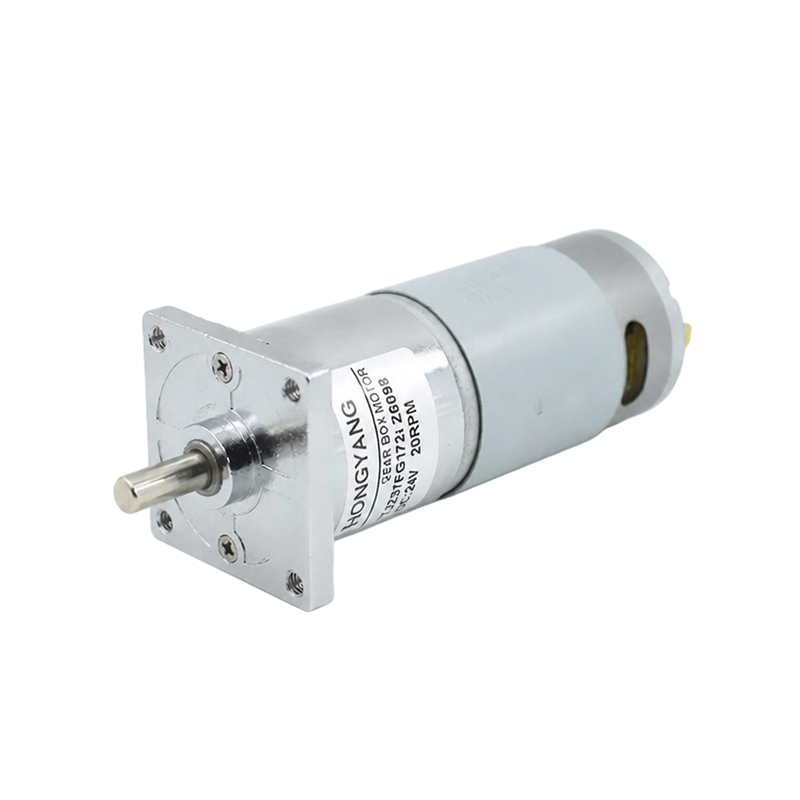
Uses straight-cut gears with teeth parallel to the shaft axis. Simple, inexpensive, and highly efficient (95–98% per stage), but generates more noise due to the abrupt tooth engagement. Common in printers, small appliances, and low-speed industrial drives. The most widely used configuration in small gear motors for cost-sensitive applications.
Helical Gear Motor
Uses angled gear teeth that engage gradually across the tooth face, producing smoother and quieter operation than spur gears. Efficiency reaches 96–98%, and they handle higher torque loads with less vibration. Widely used in conveyor drives, mixers, and packaging machinery. The angled teeth generate axial thrust forces that must be absorbed by thrust bearings.
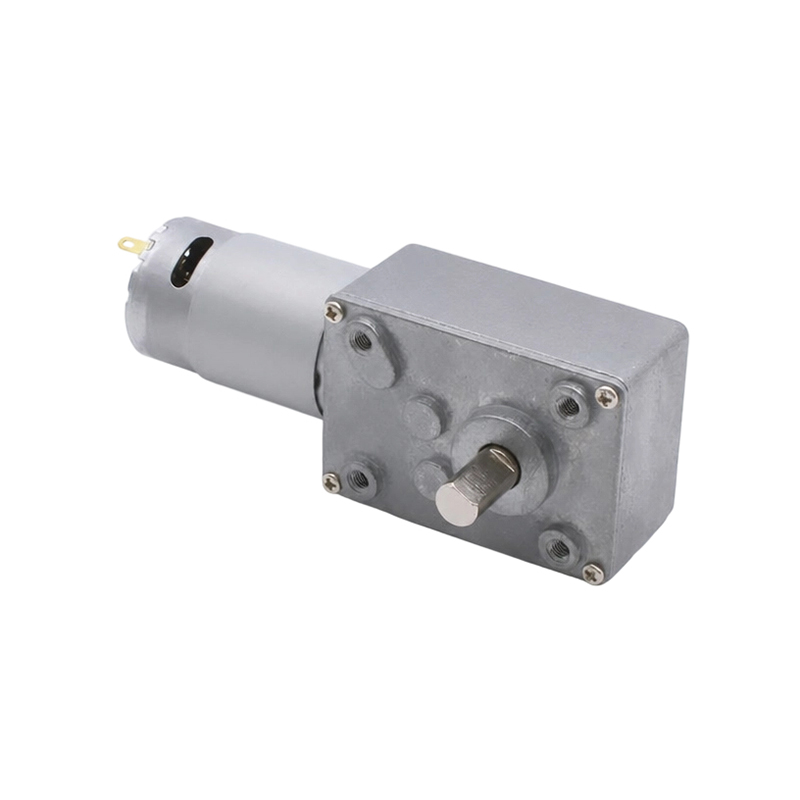
Worm Gear Motor
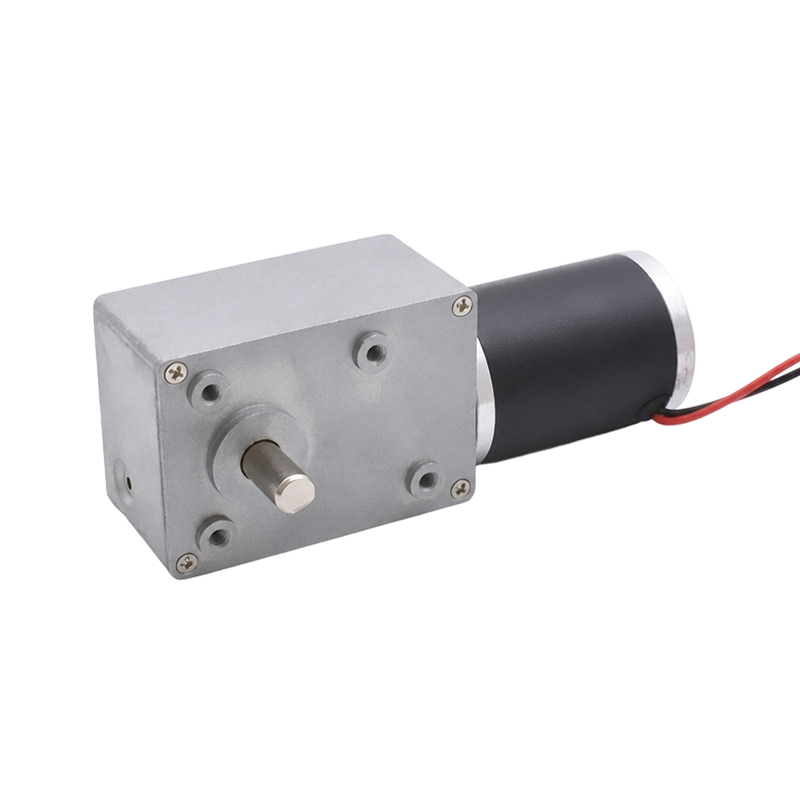
Uses a helical screw (worm) meshing with a worm wheel at a 90° angle. Achieves very high gear ratios — typically 5:1 to 100:1 in a single stage — in an extremely compact housing. The primary trade-off is efficiency: worm gear motors typically operate at 50–90% efficiency, with higher ratios being less efficient due to sliding tooth contact. Many worm gear configurations are self-locking — the load cannot back-drive the motor — making them ideal for lifting, gate openers, and positioning applications.
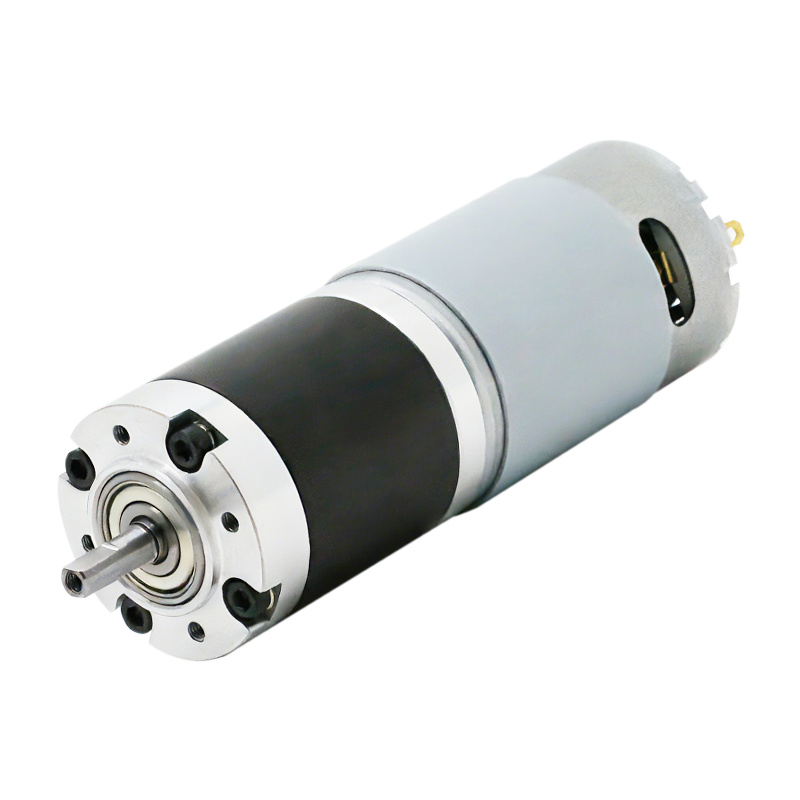
Planetary Gear Motor
Uses a central sun gear, multiple planet gears orbiting around it, and an outer ring gear. Load is distributed across multiple gear teeth simultaneously, resulting in very high torque density — a planetary gear motor can deliver 3–5 times the torque of a similarly sized spur gear unit. Efficiency is high at 95–97% per stage. Compact, coaxial (input and output share the same axis), and excellent for robotics, power tools, and electric vehicles. Also the dominant configuration in small gear motors used in precision automation.
Bevel Gear Motor
Uses conical gears to transmit power at an angle — most commonly 90° but other angles are possible. Used when the drive and load shafts must be perpendicular and space permits a right-angle configuration. Common in mixers, conveyors making direction changes, and agricultural equipment.
Gear Motor Types at a Glance: Comparison Table
| Type | Efficiency | Ratio Range | Noise Level | Torque Density | Typical Use |
|---|---|---|---|---|---|
| Spur | 95–98% | 3:1 – 10:1 per stage | Moderate–High | Low–Moderate | Printers, appliances, toys |
| Helical | 96–98% | 3:1 – 10:1 per stage | Low | Moderate–High | Conveyors, packaging |
| Worm | 50–90% | 5:1 – 100:1 per stage | Low | Moderate | Gates, lifts, mixers |
| Planetary | 95–97% | 3:1 – 10:1 per stage | Low | Very High | Robotics, EVs, automation |
| Bevel | 93–97% | 1:1 – 6:1 | Moderate | Moderate | Right-angle drives, mixers |
How a Small Gear Motor Differs From Industrial Units
A small gear motor operates on exactly the same physical principles as its industrial counterparts, but is engineered for compactness, low voltage, and low-to-moderate torque output. Most small gear motors are designed to run on 3V to 24V DC, produce output speeds from 1 RPM to 1,000 RPM, and deliver torques from a few gram-centimeters up to several Newton-meters.
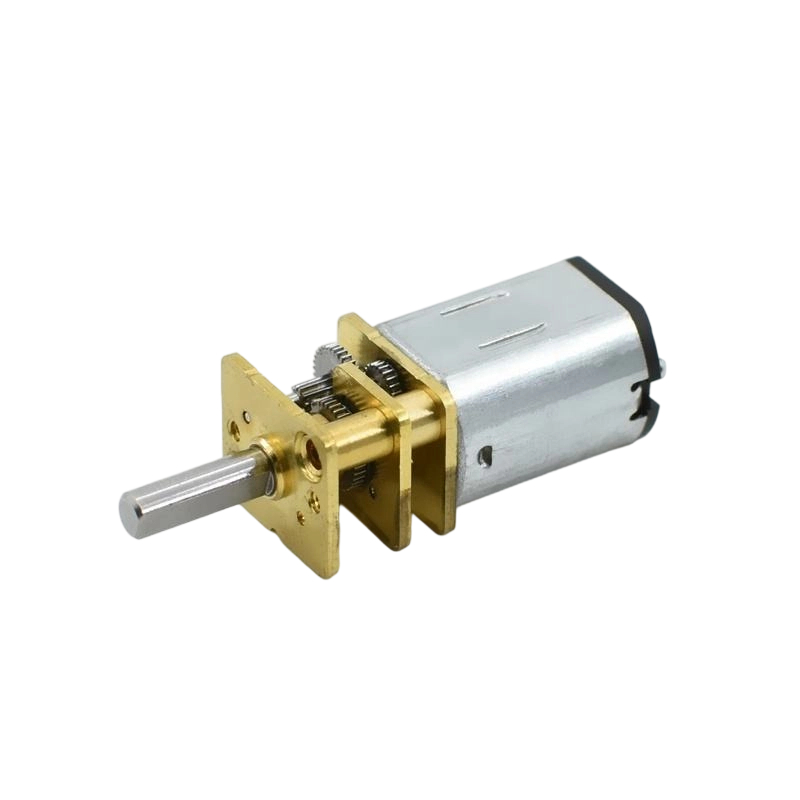
The most common small gear motor configuration is a DC brushed motor paired with a plastic or metal spur or planetary gearbox, often called an N20, N30, or TT motor by their form factor. These units are found in robotics kits, smart home devices, medical instruments, camera pan-tilt mechanisms, and automated dispensers.
Design Differences in Small Gear Motors
- Gear materials: Small gear motors often use engineered plastic (POM, nylon) gears instead of steel to reduce weight, noise, and cost — but with lower load limits, typically under 5 Nm continuous torque
- Integrated encoders: Many small gear motors include optical or magnetic encoders on the motor shaft for speed feedback and position control — essential for robotics and CNC applications
- Sealed construction: Grease-packed, sealed gearboxes eliminate the need for oil lubrication and allow any mounting orientation
- Stall torque vs. rated torque: A small gear motor rated at 0.5 Nm continuous may have a stall torque of 1.5–2 Nm — understanding this ratio prevents burnout in intermittent duty applications
Key Specifications to Understand When Selecting a Gear Motor
Every gear motor datasheet contains a set of performance parameters. Knowing how to read and apply them is essential for matching the motor to the application without over-specifying (and overspending) or under-specifying (and causing failure).
| Specification | Unit | What It Means | Practical Implication |
|---|---|---|---|
| Gear Ratio | X:1 | Input turns per output turn | Determines output speed and torque multiplication |
| Output Speed | RPM | Shaft speed under rated load | Must match application timing requirements |
| Rated Torque | Nm or kg·cm | Continuous safe operating torque | Must exceed load torque with safety margin |
| Stall Torque | Nm or kg·cm | Maximum torque before shaft stops | Running near stall overheats motor rapidly |
| No-Load Speed | RPM | Speed with zero load on output shaft | Actual working speed will be 10–20% lower |
| Rated Power | W | Continuous electrical input power | Determines power supply requirements |
| IP Rating | IPxx | Dust and moisture protection level | IP54 minimum for outdoor or wet environments |
| Backlash | arcmin or degrees | Lost motion when reversing direction | Critical for precision positioning — low backlash units cost more |
DC vs. AC Gear Motors: Which Motor Type to Choose
The electric motor inside the gearbox is just as important as the gear train. The motor type determines power supply requirements, speed control options, and suitability for different duty cycles.
DC Brushed Gear Motors
The most common motor type in small gear motors. Simple speed control by varying voltage, reversible by swapping polarity, inexpensive, and widely available from 1.5V to 48V DC. Brushes require periodic replacement after 500–2,000 hours of operation. Suitable for robotics, automotive accessories, consumer electronics, and any battery-powered application.
DC Brushless (BLDC) Gear Motors
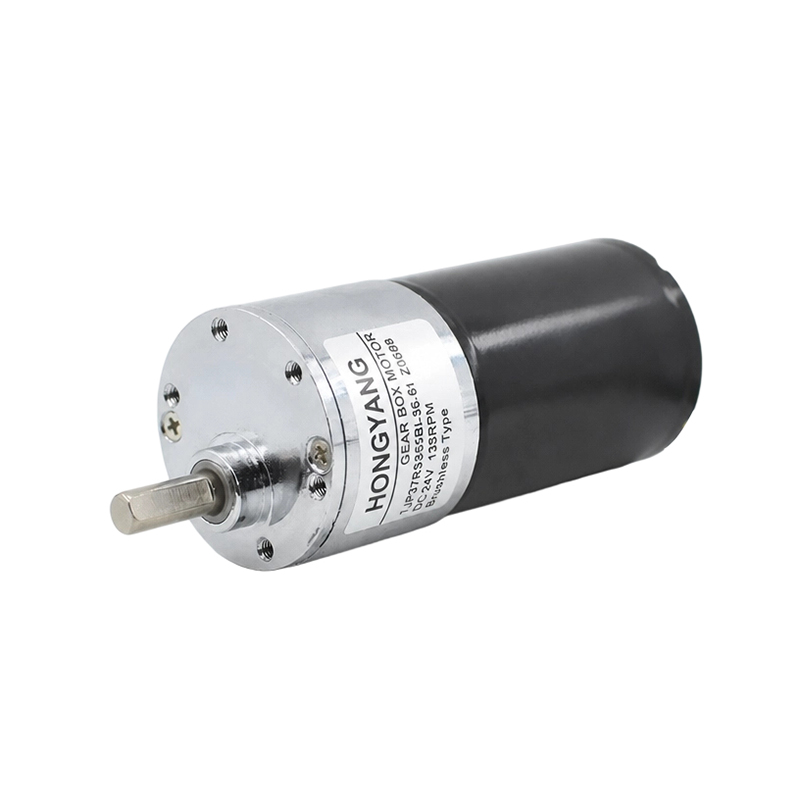
Eliminate brushes using electronic commutation, dramatically extending service life to 10,000–20,000+ hours. More efficient than brushed motors (85–93% efficiency), quieter, and better suited for continuous-duty applications. Require a motor controller (driver board), increasing system cost. Common in medical devices, HVAC dampers, drones, and precision automation.
AC Induction Gear Motors
Run directly from mains AC power (110V/220V, 50/60 Hz). No brushes, no commutator, extremely robust, and designed for continuous 24/7 industrial operation. Speed is determined by supply frequency and pole count — a 4-pole motor on 50 Hz runs at approximately 1,450 RPM (synchronous speed minus slip). Speed variation requires a Variable Frequency Drive (VFD). The standard choice for conveyors, pumps, fans, and industrial machinery.
Stepper Gear Motors
A stepper motor paired with a gearbox moves in precise angular increments — typically 1.8° per step (200 steps/revolution) before the gearbox further subdivides motion. With a 10:1 gearbox, effective resolution becomes 0.18° per step. No feedback sensor is required for open-loop positioning in light-duty applications. Common in 3D printers, CNC machines, and automated laboratory equipment.
Real-World Applications of Gear Motors by Industry
Gear motors are among the most universally deployed mechanical components in modern industry. Their ability to deliver controlled torque at precise speeds makes them indispensable across sectors.
- Industrial Automation: Conveyor drives, rotary indexing tables, mixing tanks, extruders — typically helical or planetary gear motors rated at 0.1–200 kW
- Robotics: Joint actuators in robotic arms use planetary small gear motors for their high torque density and compact footprint — a single joint motor may produce 50–300 Nm from a unit smaller than a coffee mug
- Smart Home and Building Automation: Motorized curtains, blinds, door locks, HVAC dampers, and valve actuators use small gear motors (typically 5–24V DC, 1–50 RPM) for quiet, precise positioning
- Medical Equipment: Infusion pumps, surgical tables, wheelchair drives, and lab analyzers require ultra-precise, low-noise gear motors with strict EMC compliance
- Electric Vehicles: BLDC planetary gear motors drive traction, power steering, braking assistance, and seat adjustment systems
- Food and Beverage Processing: Mixer drives, bottle cappers, and filling machines use stainless-steel gear motors with IP65–IP69K ratings for washdown resistance
- Consumer Electronics: Printers, cameras, automatic soap dispensers, and coffee machines rely on compact spur or planetary small gear motors operating at 3–12V DC
How to Size a Gear Motor: A Step-by-Step Approach
Correct sizing prevents two of the most common failure modes: thermal overload (undersized) and unnecessary cost (oversized). Follow this sequence for any gear motor selection:
- Define output speed (RPM): Determine the exact rotational speed required at the output shaft. This is set by the application — for example, a conveyor belt moving at 0.5 m/s on a 100mm diameter roller needs the roller to turn at approximately 95 RPM.
- Calculate load torque (Nm): Torque = Force × Radius. Include all friction, inertia, and gravity loads. Add a service factor of 1.25–2.0 depending on shock loading and duty cycle.
- Determine required gear ratio: Ratio = Motor Speed ÷ Required Output Speed. Most AC induction motors run at 1,400–1,750 RPM; most small DC motors at 3,000–18,000 RPM.
- Select gear type: Worm for high ratio and self-locking; planetary for high torque in small volume; helical for smooth continuous operation; spur for simple low-cost applications.
- Verify thermal rating: Confirm the motor's rated power and duty cycle match actual operating conditions. A motor rated for S1 (continuous duty) handles 100% run time; S3 (intermittent) is typically rated at 25–40% on-time.
- Check environmental requirements: Select IP rating, temperature range, and material compatibility for the installation environment.
Common Gear Motor Failure Modes and How to Prevent Them
Gear motors fail in predictable ways. Understanding the failure modes makes it possible to select more robust units, implement appropriate maintenance schedules, and diagnose problems quickly when they occur.
- Gear tooth wear and pitting: Caused by overloading, inadequate lubrication, or contamination. Produces increasing noise and backlash. Prevented by correct sizing, regular oil changes (every 2,500–5,000 hours in industrial units), and sealing against contamination.
- Bearing failure: The most common failure mode in well-maintained gearboxes. Symptoms include vibration, noise, and shaft wobble. Bearings in small gear motors typically last 5,000–15,000 hours under rated load.
- Motor winding burnout: Results from running at stall or extreme overload for extended periods. A motor operating at twice its rated torque generates approximately four times the heat — thermal damage is rapid. Prevented by using motor protection relays and correctly sizing for peak loads.
- Seal failure and oil leakage: Accelerates gear and bearing wear dramatically. Inspect shaft seals annually and replace at first sign of weeping oil.
- Plastic gear stripping in small gear motors: Occurs when impact loads or stall conditions exceed the plastic's shear strength. Use metal-geared small gear motors in any application with hard stops, jamming risk, or high inertia loads.
News
-
Brush DC Motor Origins and Physical Foundations The Brush DC Motor is a pioneer in converting electrical energy into mechanical motion, and its history is closely intertwined with ...
READ MORE -
Who Is Still Using Brushed DC Motors These Days? Brushed DC motors in small appliances Despite the growing adoption of brushless motor technology, small appliances remain a major c...
READ MORE -
Brush DC Motor Applications in Consumer Electronics and Smart Devices Brush DC Motor Role in Consumer Electronics Design Brush DC Motor plays a critical role in the design and func...
READ MORE

Quick Links
 Home
Home


Copyright © Yuyao Hongyang Micromotor Co., Ltd. All rights reserved.

