

 Eng
Eng 
 русский
 Español

 Home / News / Industry News / Why do brushed DC motors remain the cornerstone of industrial-grade drive systems worldwide, even in applications requiring precise control and harsh environments?
 Why do brushed DC motors remain the cornerstone of industrial-grade drive systems worldwide, even in applications requiring precise control and harsh environments?
 2026.02.03
 Industry News
Brush DC Motor Origins and Physical Foundations
The Brush DC Motor is a pioneer in converting electrical energy into mechanical motion, and its history is closely intertwined with the progress of modern industrial civilization. To deeply understand this motor, one must return to the most basic laws of electromagnetic induction. The Brush DC Motor represents the first successful attempt by humanity to harness electromagnetism for continuous mechanical work. While the basic principle seems simple, the underlying physics involves complex interactions between electric fields, magnetic flux, and mechanical inertia.
Core Physical Quantities and Linear Relationships
The linearization of the Brush DC Motor model is its most significant advantage in engineering. Unlike AC induction motors, which require complex vector control, the Brush DC Motor can be described by a set of first-order differential equations. The most admirable characteristic of the Brush DC Motor lies in the linearization of its mathematical model, which makes its control logic exceptionally intuitive.
The Torque-Current Identity: The relationship between torque and current is remarkably stable. In a high-quality Brush DC Motor, the torque constant is determined by the number of turns in the armature winding, the strength of the stator magnetic field, and the geometric configuration of the rotor. This means if you need more force, you simply increase the current supplied to the Brush DC Motor. This linear relationship allows for precise torque limiting and sensing by simply monitoring the current draw.
Voltage-Speed Linear Coupling: Under a constant magnetic field, increasing the input voltage causes the speed of the Brush DC Motor to rise linearly. At steady state, there is a direct linear relationship between voltage and speed, minus the resistive drop across the windings. This predictable behavior simplifies the design of closed-loop speed controllers, as the system gain remains relatively constant across the operating range.
Back Electromotive Force (Back EMF) Dynamics: Back EMF is not just a side effect; it is a fundamental feedback mechanism. This is the self-regulating mechanism of the Brush DC Motor. When the motor rotates, it simultaneously acts as a generator, producing a voltage opposite to the power supply voltage, which limits the infinite increase of current. As the Brush DC Motor accelerates, Back EMF increases, which reduces the effective voltage driving the current. This is why a Brush DC Motor naturally reaches a terminal velocity where the produced torque exactly matches the friction and load.
The Essence of Motor Rotation: Lorentz Force and Maxwell Equations
The operation of a Brush DC Motor is built entirely on the physical foundation of the Lorentz Force. When current passes through a conductor located in a magnetic field, the conductor experiences a mechanical force perpendicular to both the velocity of the electron and the magnetic flux lines. In a Brush DC Motor, this conductor is designed in the form of a coil, known as the armature winding.
Flux Density: In modern Brush DC Motors, flux density is maximized through the use of high-permeability materials in the stator, ensuring that the magnetic field is concentrated in the air gap where the armature resides. The design of the magnetic circuit must avoid saturation of the steel, which would lead to non-linear torque production and decreased efficiency.
Effective Conductor Length: This refers to the portion of the winding that actually resides within the active magnetic field. Design engineers optimize the active length to ensure maximum torque density for the Brush DC Motor. As the rotor of the Brush DC Motor spins, each set of coils cuts through the magnetic field lines, generating continuous torque. The efficiency of this process is influenced by the "slot fill factor," or the ratio of copper to insulation and air within the rotor slots.
Historical Evolution
Starting from Michael Faraday's demonstration of electromagnetic rotation devices in the 1830s, the Brush DC Motor evolved from laboratory prototypes to industrial standardization. Early designs were limited by battery technology and magnetic materials, but with the maturation of armature winding techniques and the refinement of the commutator, the Brush DC Motor rapidly became the sole power core for almost all equipment in the late 19th and mid-20th centuries. The invention of the segmented commutator and the use of carbon-based brushes transformed the Brush DC Motor into a reliable industrial tool, powering the first electric elevators and streetcars. Even with the rise of brushless technology, the Brush DC Motor still holds an extremely important position in the global motor market due to its low cost and simple control.
In-depth Disassembly: Precise Internal Construction of Brush DC Motor
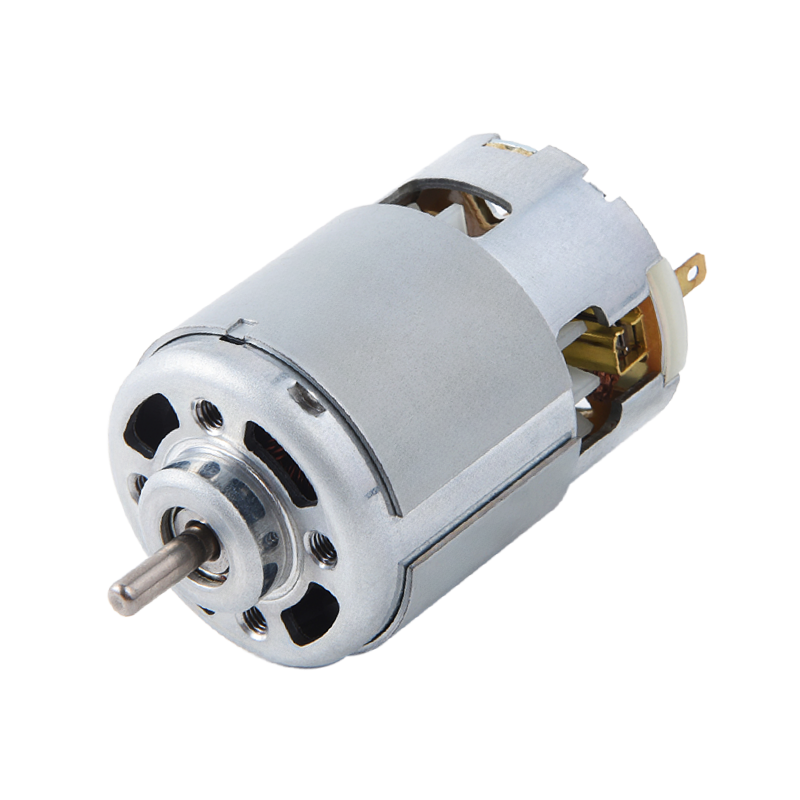
A high-performance Brush DC Motor is a system of multiple precision components working in synergy. The material selection and processing accuracy of each part directly affect the efficiency and lifespan of the motor.
Stator Components and Magnetic Circuitry
The stator is the part of the Brush DC Motor that generates a stationary magnetic field.
Permanent Magnets: In small to medium-sized Brush DC Motors, ferrite or Neodymium magnets are typically used. Ferrite magnets offer low cost and corrosion resistance, while Neodymium allows for extremely compact Brush DC Motor designs with high torque-to-weight ratios. They provide a stable magnetic flux without consuming extra power to maintain the field. High-temperature grades of Neodymium must be selected to prevent permanent demagnetization during heavy load cycles.
Housing/Frame: Usually made of high-permeability steel, providing both mechanical support and a return path for the magnetic circuit. The wall thickness is calculated to handle the magnetic flux without reaching saturation.
Rotor/Armature: The Heart of Motion
The rotor is the rotating core of the Brush DC Motor, carrying the current and generating power. It must be both magnetically efficient and mechanically robust to withstand high centrifugal forces.
Laminated Core: To reduce eddy current losses caused by rotating in the magnetic field, the rotor core of a Brush DC Motor is made of multiple layers of insulated silicon steel sheets stacked together rather than a solid steel block. If the core were solid, the changing magnetic environment during rotation would induce massive internal currents, leading to parasitic heating. Thinner laminations are used in high-speed Brush DC Motors to further reduce these losses.
Armature Windings: High-purity enameled copper wire wound within the core slots. The number of turns and wire diameter determine the torque constant and resistance of the Brush DC Motor. Lap windings and wave windings are used depending on whether the application requires high current or high voltage.
Commutation System: The Mechanical Inverter
This is the key part that distinguishes the Brush DC Motor from other motor types. The commutator of a Brush DC Motor acts as a mechanical bridge.
Commutator segments: Mounted on the shaft, consisting of multiple copper segments insulated from each other. The copper must be hard-drawn to resist wear. Each segment connects to a node of the armature winding. Its task is to constantly switch the coils connected to the circuit as the rotor turns, ensuring the torque direction remains consistent.
Brushes: These are the wear parts of the Brush DC Motor. Brush pressure must be optimized; too much pressure increases friction and wear, while too little causes brush bounce and excessive sparking. The spring mechanism must maintain consistent pressure as the brush wears down.
Key Parameter Comparison: Impact of Brush Materials on Performance
| Performance Dimension | Carbon Graphite Brush | Metal Graphite Brush | Precious Metal Brush |
| Main Application | General Industrial, Home Appliances | Car Starters, Heavy Tools | Precision Instruments, Audio |
| Conductivity | Medium | Very High | High |
| Wear Resistance | High | Medium | Lower |
| Contact Voltage Drop | 1.0 - 1.5 V | 0.2 - 0.5 V | Extremely Low |
| Current Density | 8 - 12 A/cm2 | 15 - 30 A/cm2 | Very Small |
Bearings and Cooling Design
Sleeve Bearings: Used for low-cost, low-load Brush DC Motors. They are quiet but have lower radial load capacity and are prone to wear at high temperatures.
Ball Bearings: Used for high speed and high load applications, offering a longer lifespan and lower friction. They are essential if the Brush DC Motor is driving a belt or heavy lead screw where axial and radial forces are significant.
Cooling Fan: Many Brush DC Motors integrate cooling blades to dissipate Joule heat generated in the windings. Internal airflow must be managed to prevent the accumulation of conductive carbon dust on the commutator.
Operating Mechanism: Automatic Commutation in Brush DC Motors
Mechanical Commutation Logic and Timing
Inside a Brush DC Motor, the coils on the armature must alternately change magnetic polarity. Brushes are fixed on the end cover, while the commutator rotates with the shaft. When the rotor turns to the magnetic neutral line, the brushes bridge adjacent commutator segments, reversing the current flow to that coil. In a perfectly tuned Brush DC Motor, this reversal occurs exactly when the coil is at the magnetic neutral axis to minimize sparking. This timing can be "advanced" in some high-speed Brush DC Motors to compensate for the time it takes for current to reverse in an inductive coil.
Alternation of Magnetic Polarity and Lorentz Force
According to the left-hand rule, when the current direction reverses in a magnetic field, the force direction also reverses. The commutator of the Brush DC Motor ensures that no matter where the rotor turns, the current direction of the coils under a specific magnetic pole remains synchronized, thus maintaining unidirectional electromagnetic torque. Each coil essentially sees an alternating current as it passes from the North pole to the South pole of the stator. The smoothness of the resulting torque is determined by the number of segments in the commutator; more segments lead to lower "torque ripple."
Analysis of Armature Reaction and Compensation
As the load on a Brush DC Motor increases, the magnetic field generated by the armature distorts the main magnetic field of the stator. This is known as "armature reaction." It causes the ideal commutation point to shift away from the geometric neutral axis. In large Brush DC Motors, this distortion can be so severe that it causes brushes to spark excessively. High-end Brush DC Motors use small interpoles or compensating windings to neutralize this armature reaction in the commutation zone, ensuring clean switching even under heavy load.
Core Classification: Brush DC Motor Families Defined by Excitation
Permanent Magnet (PMDC)
Compact structure and high efficiency. Since there are no excitation losses (no power is used to create the stator field), its control linearity is the best among Brush DC Motors, making it the standard for small-scale robotics and automotive accessories. PMDC motors are however limited in their ability to perform "field weakening," a technique used to achieve ultra-high speeds at the expense of torque.
Shunt Wound
The stator and armature are connected in parallel. This creates a self-regulating speed characteristic. It has excellent constant speed characteristics, with very low speed fluctuation when the load changes. This is because the field strength is independent of the armature current, making them ideal for precision machining where a constant RPM is required.
Series Wound
The stator and armature are connected in series. It possesses extremely high starting torque because the field strength increases proportionally with the armature current. This makes them perfect for winches, cranes, and heavy-duty traction. However, it must be noted that when a Brush DC Motor uses this method, it is strictly forbidden to run without a load. In a no-load condition, the field becomes very weak while the armature current remains sufficient to accelerate the rotor to dangerous speeds, a phenomenon known as "runaway."
Excitation Method Comparison Table
| Parameter/Feature | Permanent Magnet (PMDC) | Shunt Wound | Series Wound |
| Starting Torque | Medium | General | Extremely High |
| Speed Stability | Good | Excellent | Poor |
| No-load Behavior | Stable | Stable | Dangerous |
| Typical Efficiency | High (85%+) | Medium (75-80%) | Medium (70-80%) |
Performance Indicators and Characteristic Curves
Torque-Speed Curve (The T-N Curve)
The ideal characteristic curve of a Brush DC Motor is a straight line with a fixed slope. A steep slope indicates a motor with high internal resistance, which means it will lose more speed under load. A shallow slope indicates a "stiff" motor that maintains speed well. Key points include Stall Torque (torque at zero speed) and No-load Speed (speed at zero torque). Maximum efficiency usually occurs at about 70-80% of the no-load speed.
Dynamic Balance of Back EMF and Power Balance
When the Brush DC Motor rotates, it generates Back EMF which limits the current. The mechanical power output is the product of Back EMF and armature current. This dynamic balance ensures that the Brush DC Motor adjusts its current consumption based on the mechanical load applied to the shaft. In high-precision applications, the Back EMF can be sampled during the "off" period of a PWM signal to provide speed feedback without the need for an external encoder.
Microscopic Composition of Efficiency Losses
Copper Loss: Heat generated in the copper windings due to electrical resistance. This is usually the largest loss component in a Brush DC Motor.
Iron Loss: Energy dissipated as heat in the rotor core due to magnetic hysteresis and eddy currents.
Mechanical Loss: Friction losses in bearings, windage (air resistance of the spinning rotor), and friction between brushes and the commutator.
Stray Loss: Losses that are difficult to categorize, such as those caused by commutation sparks and magnetic flux leakage.
Drive and Speed Control Strategies
Pulse Width Modulation (PWM) Technology
PWM is the standard for modern Brush DC Motor control. It adjusts the duty cycle (the ratio of "on" time to total cycle time) to change the average voltage applied across the motor. The inductance of the Brush DC Motor acts as a low-pass filter, keeping the current relatively smooth despite the pulsing voltage. Choosing the right frequency is vital; frequencies within the human hearing range (20Hz - 20kHz) can cause audible humming, while frequencies that are too high increase the switching losses in the drive electronics.
H-Bridge Circuit and Four-Quadrant Operation
An H-Bridge consists of four switching elements (typically MOSFETs). By controlling the conduction of diagonal switches, it is possible to achieve forward rotation, reverse rotation, and electronic braking. A true industrial Brush DC Motor controller allows for four-quadrant operation: forward driving, forward braking (regeneration), reverse driving, and reverse braking. This is essential for applications like electric vehicles or elevators where energy needs to be recovered during deceleration.
Selection Guide: Matching the Best Brush DC Motor for Your Project
Thermal Management and Duty Cycle
Heat is the primary enemy of the Brush DC Motor. When selecting a motor, one must consider the duty cycle (S1 through S10 ratings). A motor rated for continuous operation (S1) is much larger than an intermittent one of the same power because it must dissipate heat as fast as it is generated. Excessive heat can degrade brush lubricants, melt wire insulation, and weaken permanent magnets.
Core Selection Parameters
When selecting, focus on: Rated Voltage, Continuous Torque, Stall Current, and Torque Constant. The stall current is particularly important for sizing the power supply and drive electronics to ensure they can handle the high current surge during startup or in the event of a mechanical jam.
Maintenance, Troubleshooting, and Lifespan Extension
The Art of Brush Seating
New brushes in a Brush DC Motor do not perfectly fit the curvature of the commutator. Seating involves running the motor at low load for several hours or using specialized abrasive "seating stones" to ensure 100% contact area. Proper seating prevents localized overheating and excessive arcing, which can significantly extend the life of the Brush DC Motor.
Troubleshooting Table
| Symptom | Possible Cause | Solution |
| Excessive Sparking | Low brush pressure, uneven commutator, carbon dust buildup | Check springs, resurface commutator, clean with air |
| Motor Overheating | Long-term overload, blocked ventilation, worn bearings | Reduce load, clean cooling paths, replace bearings |
| Abnormal Vibration | Bearing wear, loose mounting, rotor imbalance | Replace bearings, tighten fasteners, re-balance rotor |
Industry Applications: The Irreplaceability of Brush DC Motors
The Brush DC Motor thrives where simplicity and cost-effectiveness are king. In the automotive industry, they are used for power windows, wipers, and seat adjustments due to their reliability and the simplicity of their wiring. In medical equipment, they power precision pumps and surgical tool actuators where smooth, low-speed torque is required. In power tools like drills and grinders, their high starting torque is a critical advantage for breaking through tough materials. Even in space exploration, Brush DC Motors are favored for deployment mechanisms because their drive electronics are simpler and more resistant to cosmic radiation than the complex processors required for brushless control.
FAQ:
Why is the Brush DC Motor still irreplaceable despite brushless motors?
Mainly due to the extreme simplicity of its control system. The Brush DC Motor is plug-and-play; in emergency systems, you can simply connect a battery and it will run without complex microcontrollers or sensors. It also provides a better torque-to-cost ratio in many low-power applications.
How do I know when the brushes of a Brush DC Motor need replacing?
Visually inspect the wear length; most brushes have a "wear line" indicated. Also, monitor the spark color; blue sparks are normal, but large orange or green sparks indicate that the brushes are depleted, the spring pressure is too low, or the commutator is damaged.
How can I reduce Electromagnetic Interference (EMI)?
Connect a bypass capacitor between the terminals or add magnetic beads to the leads. Using a shielded cable and ensuring the motor housing is grounded can also trap high-frequency switching noise inside the motor system.
Can this motor be used as a generator?
Yes. Permanent Magnet (PMDC) types will naturally generate DC voltage when rotated by an external force. This makes them popular for small-scale wind turbines or as tachometers to measure rotational speed.
Why is the starting current of a Brush DC Motor so large?
At zero RPM, there is no Back EMF to oppose the battery voltage. The current is limited only by the wire resistance, often reaching 5 to 10 times the normal running current. This is why many Brush DC Motor controllers include a "soft-start" feature.
What are the advantages of a Coreless design?
By removing the heavy iron core from the rotor, rotational inertia is extremely low and "cogging" (the magnetic attraction between the rotor and stator at rest) is eliminated. This makes coreless Brush DC Motors exceptionally smooth and responsive for precision medical scanning, high-end audio, and gimbal controls.
News
-
Brush DC Motor Origins and Physical Foundations The Brush DC Motor is a pioneer in converting electrical energy into mechanical motion, and its history is closely intertwined with ...
READ MORE -
Who Is Still Using Brushed DC Motors These Days? Brushed DC motors in small appliances Despite the growing adoption of brushless motor technology, small appliances remain a major c...
READ MORE -
Brush DC Motor Applications in Consumer Electronics and Smart Devices Brush DC Motor Role in Consumer Electronics Design Brush DC Motor plays a critical role in the design and func...
READ MORE

Quick Links
 Home
Home


Copyright © Yuyao Hongyang Micromotor Co., Ltd. All rights reserved.

