

 Eng
Eng 
 русский
 Español


What Is a DC Gear Motor? Types, Uses & How It Works
 2026.04.15
 Industry News
What Is a DC Gear Motor? The Direct Answer
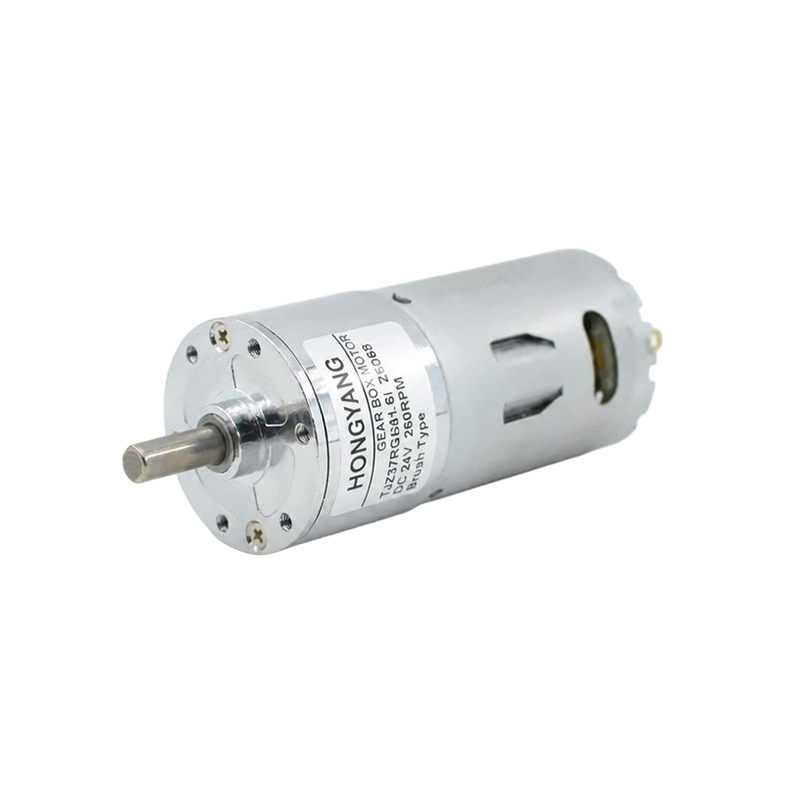
A DC gear motor is a direct current electric motor integrated with a gear reducer (gearbox). The motor converts electrical energy into rotational mechanical energy, while the attached gearbox reduces the output speed and proportionally increases the output torque. The result is a compact, self-contained drive unit that delivers high torque at low speed—a combination that a standard DC motor alone cannot achieve efficiently.
In practical terms: if a bare DC motor spins at 5,000 RPM but you need 50 RPM to drive a conveyor belt with strong pulling force, a gear motor with a 100:1 gear ratio delivers exactly that—while multiplying torque by roughly 100 times (minus gear efficiency losses, typically 70–95%).
DC gear motors are among the most widely used motion components in engineering, appearing in everything from robotic arms and electric wheelchairs to automatic car windows and industrial assembly lines.
How a DC Gear Motor Works: The Core Mechanism
Understanding a DC gear motor requires understanding its two integrated systems working in sequence.
The DC Motor Stage
When DC voltage is applied to the motor's input terminals, current flows through the armature windings inside a magnetic field (created by permanent magnets or electromagnets). This interaction produces a rotational force—torque—that spins the motor shaft. The speed of rotation depends on the applied voltage, while torque depends on the current. Most small DC gear motors operate on 3V, 6V, 12V, or 24V supply voltages.
The Gearbox Stage
The motor shaft feeds directly into a gearbox containing a series of meshing gears. Each gear stage reduces speed by a fixed ratio and multiplies torque. For example, a two-stage gearbox with a 10:1 ratio at each stage produces an overall 100:1 reduction. The output shaft of the gearbox turns at 1/100th of the motor speed but with up to 100 times the torque (before efficiency losses).
The Torque-Speed Trade-Off
This is the fundamental engineering principle behind every gear motor: speed and torque are inversely proportional at a given power input. Doubling the gear ratio halves the output speed and doubles the output torque. This allows engineers to precisely tune a drive system to match the mechanical demands of any application without changing the motor itself.
Main Types of DC Gear Motors
DC gear motors are classified by the type of DC motor used and by the gearbox configuration. Each combination suits different performance requirements.
By Motor Type
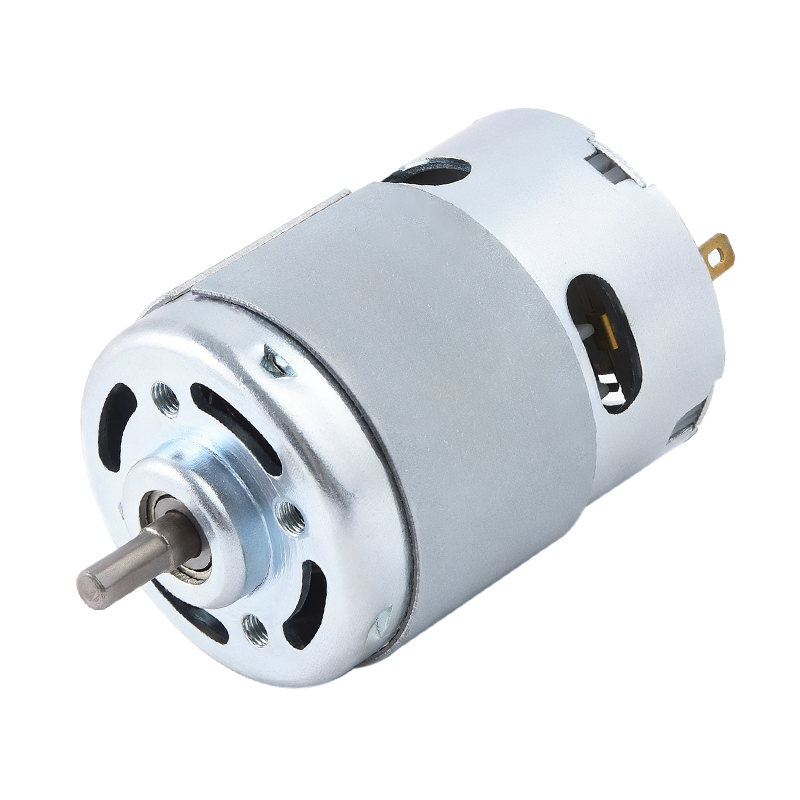
- Brushed DC gear motor: Uses carbon brushes and a commutator to transfer current to the rotating armature. Simple, low-cost, and easy to control with basic PWM circuits. Brushes wear over time, typically requiring replacement after 500–2,000 hours of operation. Common in toys, actuators, and low-duty-cycle applications.
- Brushless DC (BLDC) gear motor: Eliminates brushes by using electronic commutation. Offers longer service life (often 10,000+ hours), higher efficiency (85–95%), lower electromagnetic interference, and better heat management. Used in medical devices, drones, and precision automation.
- Coreless DC gear motor: The armature has no iron core, making it extremely lightweight and highly responsive with very low inertia. Ideal for handheld surgical tools, prosthetics, and camera systems where fast, precise micro-movements matter.
By Gearbox Type
- Spur gear motor: Uses straight-cut parallel gears. Simple, economical, and widely available. Slightly noisier than other types due to sudden tooth engagement. Best for moderate-speed, moderate-load applications.
- Helical gear motor: Gears are cut at an angle, providing gradual tooth engagement. This results in smoother, quieter operation and higher load capacity than spur gears. Preferred in office automation, HVAC systems, and food processing equipment.
- Planetary gear motor: Features a central sun gear, surrounding planet gears, and an outer ring gear. This design achieves very high torque density and gear ratios up to 1,000:1 in a compact cylindrical form. Commonly used in robotics, electric vehicles, and high-precision actuators.
- Worm gear motor: Uses a worm screw meshing with a worm wheel, enabling very high reduction ratios (up to 300:1 in a single stage) and inherent self-locking when power is removed. Ideal for lifts, gate openers, and any application requiring the load to hold position without braking.
Key Specifications Explained
Selecting the right DC gear motor requires understanding these core parameters. Misreading even one can result in motor failure or underperformance.
| Specification | Unit | What It Means | Typical Range |
|---|---|---|---|
| Rated Voltage | V (DC) | Optimal operating voltage | 3V – 48V |
| No-Load Speed | RPM | Output shaft speed with no load | 1 – 1,000 RPM |
| Rated Torque | N·m or kg·cm | Continuous safe output torque | 0.01 – 500 N·m |
| Stall Torque | N·m or kg·cm | Maximum torque at zero speed | 2–10× rated torque |
| Gear Ratio | n:1 | Input-to-output speed reduction | 5:1 – 1,000:1 |
| Efficiency | % | Power converted to useful output | 50% – 95% |
| Rated Current | A | Current draw at rated load | 0.05A – 30A |
| IP Rating | IP code | Dust and water protection level | IP20 – IP67 |
Design rule of thumb: Always select a gear motor whose rated torque is at least 1.5–2× your application's calculated load torque. This safety margin accounts for startup surges, friction variation, and load fluctuations that can easily exceed steady-state values.
DC Gear Motor vs. Other Motor Types
Engineers frequently evaluate DC gear motors against alternatives. Here is how they compare on the most critical factors.
| Factor | DC Gear Motor | AC Gear Motor | Stepper Motor | Servo Motor |
|---|---|---|---|---|
| Power Source | DC (battery/PSU) | AC mains | DC (pulsed) | DC or AC |
| Speed Control | Easy (PWM/voltage) | Moderate (VFD needed) | Step-based | Excellent (closed-loop) |
| Torque at Low Speed | High | Moderate | High (but drops off) | Very High |
| Position Accuracy | Low (open-loop) | Low | Good (open-loop) | Excellent |
| Cost | Low – Moderate | Moderate | Low – Moderate | High |
| Portability | Excellent | Poor | Good | Good |
The DC gear motor's strongest competitive advantages are its simplicity, low cost, and battery compatibility—making it the default choice for mobile, portable, and cost-sensitive applications.
Real-World Applications of DC Gear Motors
DC gear motors are embedded in an extraordinary range of products. Their versatility comes from the wide range of available voltages, gear ratios, and form factors.
Automotive Systems
Modern vehicles contain 20–70 DC gear motors depending on the model. These drive power windows (typically 12V, 30–60 RPM), electric seat adjusters, HVAC blend door actuators, windshield wiper systems, and power steering assist units. The reliability requirement in automotive environments drives the use of high-efficiency brushless variants with IP65+ ratings.
Robotics and Automation
Robot joints, grippers, and mobile platforms depend on DC gear motors for controlled movement. Planetary gear motors are the standard here, offering gear ratios from 20:1 to 500:1 in a diameter as small as 22 mm. Educational robots like those using the LEGO Technic platform and industrial collaborative robots (cobots) from companies like Universal Robots both rely on this core technology.
Medical and Assistive Devices
Electric wheelchairs use 24V brushless DC gear motors delivering 80–150 N·m of torque to move users safely across varied terrain. Infusion pumps, surgical robots, powered prosthetic limbs, and hospital bed adjustment mechanisms all depend on the precision and reliability of compact DC gear motors.
Consumer Electronics and Home Appliances
Automatic curtain systems, smart locks, paper shredders, espresso machine grinders, and electric can openers all use small DC gear motors. These typically operate on 6V–12V with gear ratios between 10:1 and 100:1, balancing quiet operation with sufficient torque for everyday tasks.
Industrial Equipment
Conveyor systems, packaging machines, textile equipment, and agricultural machinery use heavy-duty DC gear motors rated from 100W to several kilowatts. Worm gear motors are common here for their self-locking property, which prevents back-driving when power is cut—an important safety feature on vertical or inclined conveyor sections.
How to Select the Right DC Gear Motor for Your Application
Follow this structured selection process to avoid the most common specification mistakes.
- Define your load torque. Calculate or measure the torque your application needs at the output shaft. Include friction, inertia, and any incline loads. Add a 1.5–2× safety factor to determine your minimum rated torque requirement.
- Set your required output speed. Determine the RPM range needed at the output. This, combined with your torque target, helps define the power rating (Power = Torque × Angular Velocity).
- Choose your supply voltage. Match the motor voltage to your available power source—battery bank, power supply, or vehicle electrical system. This narrows the candidate list significantly.
- Select the gearbox type. Use planetary for high torque density and precision; worm for self-locking; helical for quiet continuous duty; spur for simple, low-cost applications.
- Check duty cycle. Continuous duty (S1) motors are rated for sustained operation. Intermittent duty (S2, S3) motors can handle higher peak loads but need rest periods. Overrunning a motor beyond its duty cycle is the most common cause of premature failure.
- Consider environmental requirements. For outdoor or washdown environments, specify IP54 or higher. For food processing, stainless steel housings and NSF-compliant lubricants are required.
- Factor in control method. Simple on/off control needs only a relay or MOSFET switch. Variable speed requires a PWM controller. Closed-loop position control requires an encoder-equipped motor and a motion controller.
Controlling a DC Gear Motor: Methods and Components
DC gear motors are among the easiest drive components to control electronically, which contributes to their dominance in battery-powered and microcontroller-based systems.
PWM Speed Control
Pulse-Width Modulation (PWM) varies the average voltage delivered to the motor by rapidly switching power on and off. A 50% duty cycle at 12V delivers the equivalent of 6V average, roughly halving the speed. PWM is efficient (losses under 5% in well-designed circuits) and allows smooth, stepless speed adjustment from a microcontroller like an Arduino or Raspberry Pi.
H-Bridge for Bidirectional Control
An H-bridge circuit contains four switches arranged in an "H" shape around the motor. By activating different switch pairs, the current direction through the motor reverses, reversing rotation. H-bridge ICs such as the L298N, DRV8833, or TB6612FNG are widely used in robotics projects for convenient bidirectional control with current ratings from 0.6A to 4A.
Encoders for Position and Speed Feedback
Adding a quadrature encoder to the motor shaft provides real-time speed and position data. Many DC gear motors are available with integrated encoders offering resolutions of 64 to 1,000 counts per revolution. This enables closed-loop PID control, where the system automatically adjusts voltage to maintain a target speed or reach a precise position—transforming a simple gear motor into a capable precision actuator.
Common Failure Modes and How to Prevent Them
DC gear motors are robust, but specific operating conditions accelerate wear and cause premature failure.
- Overloading beyond stall torque: Sustained operation at stall causes excessive current draw (often 5–10× rated current), rapidly overheating the windings. Always protect with a current-limiting circuit or thermal cutoff switch.
- Gear lubrication failure: Dry gears wear exponentially faster. Planetary and spur gearboxes use grease that can dry out after several years. Regrease sealed gearboxes at manufacturer-recommended intervals, or choose oil-bath gearboxes for long-life applications.
- Brush wear (brushed motors): Inspect brushes every 500–1,000 hours. Worn brushes cause arcing, increased electrical noise, and eventual commutator damage. Replace brushes before they wear to the minimum length marked on the brush holder.
- Moisture ingress: Water corrodes windings and contaminates gear lubricant. Always match the IP rating to the environment. Do not use an IP20-rated motor in outdoor or splash-prone locations.
- Voltage spikes: Back-EMF when the motor switches off can damage driver circuits. Always add a flyback diode across the motor terminals to clamp voltage spikes when using transistor or MOSFET drivers.
News
-
Brush DC Motor Origins and Physical Foundations The Brush DC Motor is a pioneer in converting electrical energy into mechanical motion, and its history is closely intertwined with ...
READ MORE -
Who Is Still Using Brushed DC Motors These Days? Brushed DC motors in small appliances Despite the growing adoption of brushless motor technology, small appliances remain a major c...
READ MORE -
Brush DC Motor Applications in Consumer Electronics and Smart Devices Brush DC Motor Role in Consumer Electronics Design Brush DC Motor plays a critical role in the design and func...
READ MORE

Quick Links
 Home
Home


Copyright © Yuyao Hongyang Micromotor Co., Ltd. All rights reserved.

