

 Eng
Eng 
 русский
 Español


How Does a Brush DC Motor Work? Complete Guide
 2026.05.06
 Industry News
A brushed DC electric motor works by using direct current electricity, a magnetic field, and a mechanical switching system (brushes and commutator) to convert electrical energy into continuous rotational motion. When current flows through wire coils wound around a rotating armature, the magnetic force generated causes the armature to spin. Carbon brushes press against a segmented copper commutator to continuously reverse current direction in the coils — keeping the armature rotating in one direction. This elegant, self-contained mechanism has powered everything from toy cars to industrial machinery for over 150 years.
Core Working Principle of a Brushed DC Electric Motor
The operation of a brush DC motor is grounded in two fundamental physics laws: Faraday's Law of Electromagnetic Induction and the Lorentz Force Law. When a current-carrying conductor is placed inside a magnetic field, it experiences a mechanical force. The direction and magnitude of that force follow the equation:
F = BIL — where F is force (Newtons), B is magnetic flux density (Tesla), I is current (Amperes), and L is the length of the conductor in the field (meters).
In a brushed DC motor, multiple conductor loops (the armature windings) are arranged around a central rotating shaft. The magnetic field is provided either by permanent magnets (common in micro brush DC motors) or electromagnets called field windings (more common in larger industrial motors). As current flows through the armature coils, opposing magnetic forces on opposite sides of the coil create a torque — a rotational turning force — causing the shaft to spin.
The critical challenge is this: without intervention, a coil would rotate 90° to align with the field and stop. The commutator solves this by reversing the current at exactly the right moment, keeping the force always pushing in the same rotational direction.
Anatomy of a Brushed DC Electric Motor
Understanding each component clarifies how the whole system produces continuous rotation:
Stator (Stationary Field)
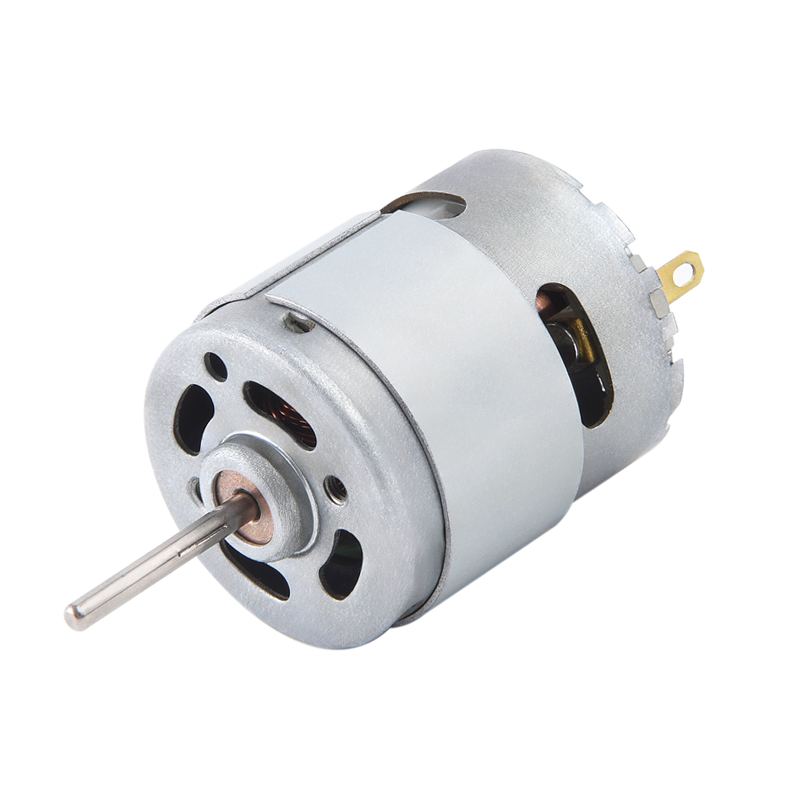
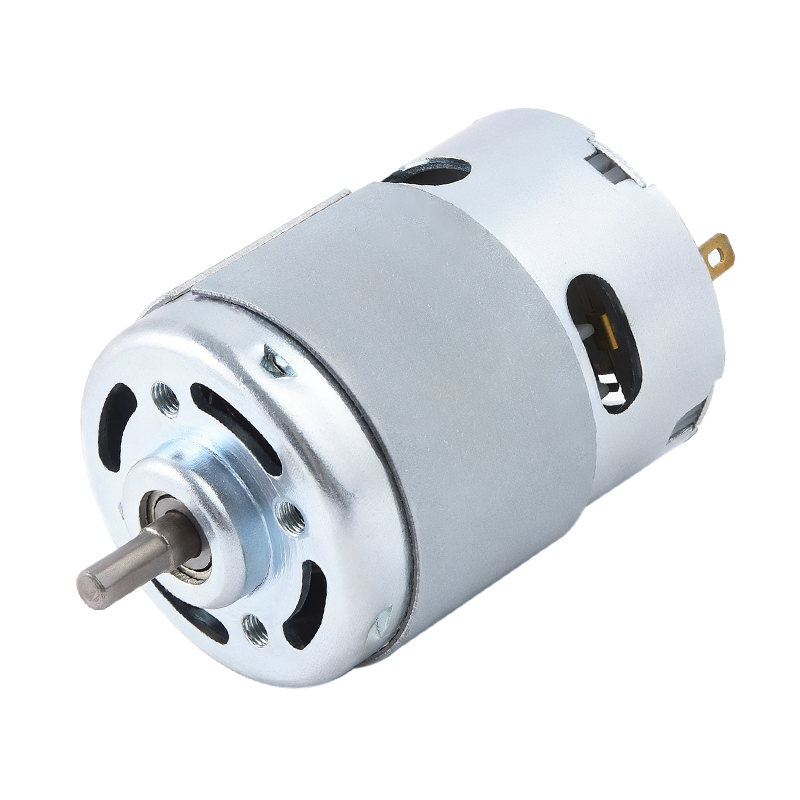
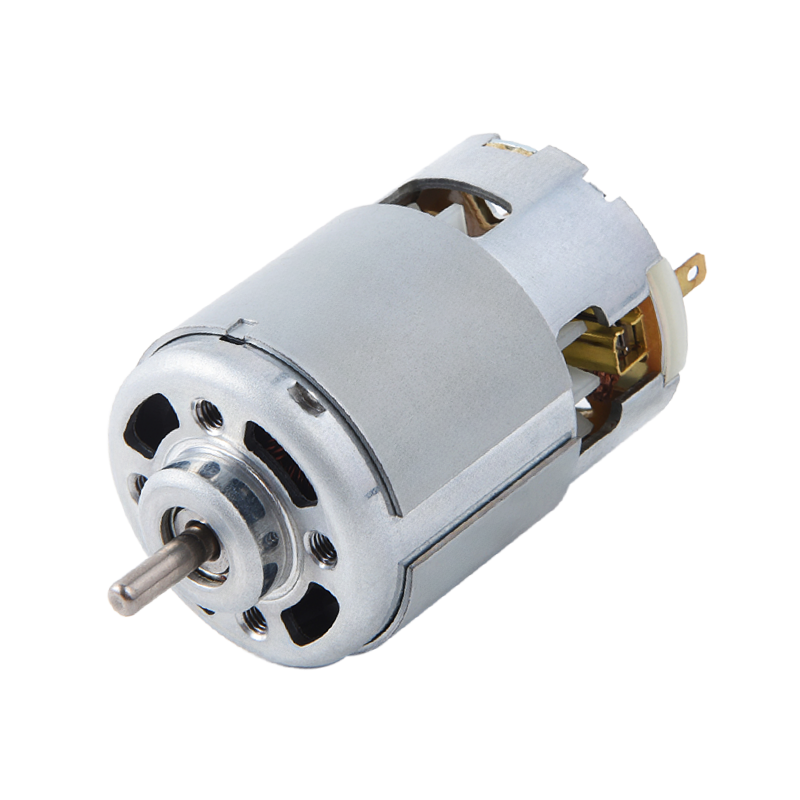
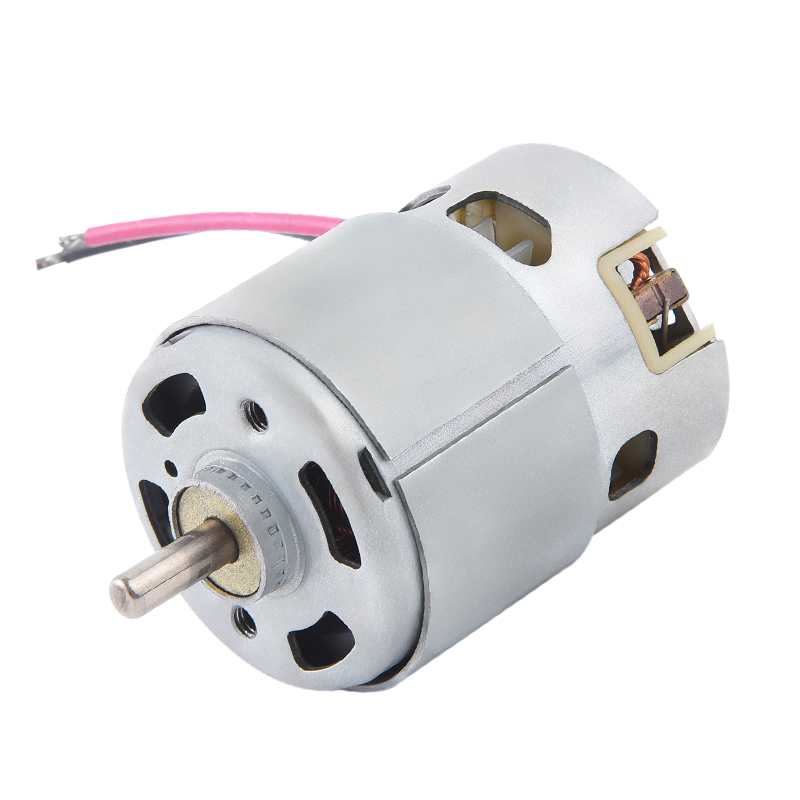
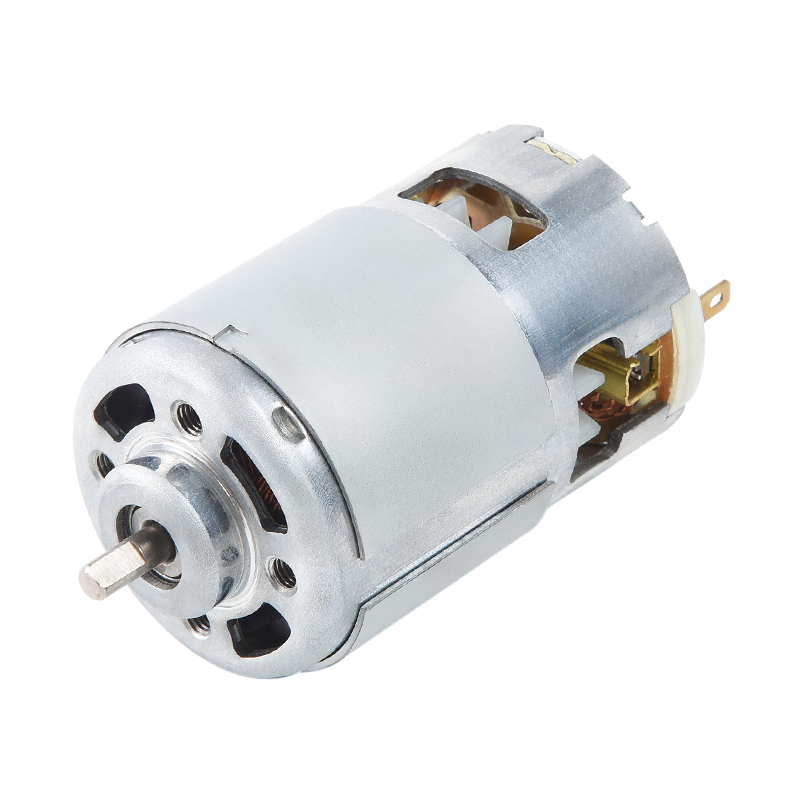
The stator is the fixed outer frame of the motor. In small and micro brush DC motors, the stator typically contains permanent magnets (ferrite or neodymium) that produce a constant magnetic field. In larger brushed DC electric motors, the stator holds wound field coils that generate an electromagnet when powered. The stator creates the fixed magnetic environment in which the rotor operates.
Rotor / Armature
The rotor (also called the armature) is the rotating core. It consists of a laminated iron core with multiple slots into which copper wire coils are wound. Laminating the core reduces energy-wasting eddy currents. The more coil windings present, the smoother the torque output. A typical small brushed DC motor may have 3 to 12 armature poles, while precision micro motors can have more for ultra-smooth operation.
Commutator
The commutator is a cylindrical assembly of copper segments mounted on the rotor shaft, separated by insulating mica gaps. Each segment connects to a specific armature coil. As the shaft rotates, different segments come into contact with the brushes, effectively routing current to whichever coil is in the optimal position to generate forward torque. This is the mechanical rectifier that allows DC current to produce continuous rotation.
Brushes
Brushes are stationary conductive contacts — usually made from carbon-graphite composite — that press against the spinning commutator under spring tension. They serve as the electrical bridge between the fixed external circuit and the rotating armature. Carbon is chosen because it is electrically conductive, self-lubricating, and soft enough to wear preferentially rather than damaging the copper commutator. Brush contact resistance typically adds 0.5–2V of voltage drop to the circuit.
Bearings and Housing
Ball or sleeve bearings support the rotor shaft and allow low-friction rotation. The motor housing (yoke) mechanically contains all components and, in motors with wound field coils, also serves as a magnetic flux return path.
Step-by-Step: How a Brush DC Motor Works in Motion
Here is the complete operating cycle broken into sequential steps:
- DC voltage is applied across the two brush terminals, driving current into the circuit.
- Current flows through the brushes into the commutator segment currently in contact, then into the connected armature coil.
- The energized coil generates a magnetic field around itself, which interacts with the stator's permanent or electromagnet field.
- The Lorentz force acts on the coil conductors — one side is pushed forward, the opposite side pushed backward — creating rotational torque on the shaft.
- The rotor begins to spin, rotating the commutator with it.
- As the coil approaches magnetic alignment (the "dead zone"), the commutator segments shift contact to the next coil's segments.
- Current is reversed in the original coil and fed into the next optimally positioned coil, maintaining continuous torque.
- This cycle repeats dozens to thousands of times per second, producing smooth, continuous shaft rotation.
The speed of rotation is directly proportional to the applied voltage (at constant load), and torque output is proportional to current. This simple linear relationship makes brushed DC motors exceptionally easy to control — speed up by raising voltage, slow down by lowering it, reverse by swapping polarity.
Types of Brushed DC Electric Motors
Brushed DC motors are categorized by how the field winding (if present) is connected relative to the armature:
| Motor Type | Field Connection | Speed Regulation | Typical Use |
|---|---|---|---|
| Permanent Magnet | No field winding | Linear with voltage | Micro motors, toys, robotics |
| Series Wound | In series with armature | Poor (varies with load) | High-torque starts (cranes, drills) |
| Shunt Wound | In parallel with armature | Good (nearly constant) | Machine tools, fans, pumps |
| Compound Wound | Both series + shunt | Moderate | Elevators, compressors |
The permanent magnet brushed DC motor is by far the most common in consumer and micro applications. Its simple two-wire interface (positive = forward, swap = reverse) makes it trivially easy to integrate into circuits.
Micro Brush DC Motors: Miniaturization and Key Specifications
Micro brush DC motors are simply miniaturized versions of standard brushed DC electric motors, operating under the same electromagnetic principles but scaled down to fit precision applications. They typically range from 4mm to 36mm in diameter and operate on voltages between 1.5V and 24V DC.
Common Specifications of Micro Brush DC Motors
- Voltage range: 1.5V–24V (most common: 3V, 5V, 6V, 12V)
- No-load speed: 1,000–30,000 RPM depending on voltage and winding
- Stall torque: 0.1–500 mN·m (millinewton-meters)
- Efficiency: Typically 50–75% at optimal operating point
- Weight: As light as 2–3 grams for the smallest models
- Brush life: Typically 500–2,000 hours of continuous operation
Where Micro Brush DC Motors Are Used
Despite the rise of brushless alternatives, micro brush DC motors remain dominant in countless everyday products due to their low cost and simplicity:
- Medical devices: Infusion pumps, handheld surgical tools, dental drills, hearing aids
- Consumer electronics: Camera autofocus mechanisms, optical disc drives, electric toothbrushes
- Automotive: Power mirrors, seat adjusters, window regulators, HVAC blend doors
- Robotics and hobbyist: RC vehicles, drone gimbals, small robot actuators
- Industrial automation: Precision positioning stages, valve actuators, label dispensers
A standard 130-size brushed DC motor (used in countless RC toy cars) measures just 20mm × 15mm, weighs under 15 grams, and delivers 12,000–15,000 RPM on a 3V supply — making it one of the most cost-effective motion solutions available at under $0.50 per unit in volume.
Speed and Torque: How to Control a Brush DC Motor
The brushed DC motor's linear characteristics make it one of the most controllable motor types available. Three primary methods are used:
Voltage Control
Motor speed is approximately proportional to applied voltage. Doubling the voltage roughly doubles the no-load speed. For a motor rated at 12V / 5,000 RPM, applying 6V yields approximately 2,500 RPM. This relationship holds until magnetic saturation or significant load is present.
PWM (Pulse Width Modulation)
The most efficient speed control method. PWM rapidly switches the supply voltage on and off at frequencies typically between 1 kHz and 50 kHz. A 50% duty cycle delivers half the average voltage, achieving half-speed with far less heat generation than resistive voltage reduction. PWM controllers using MOSFETs can achieve 95%+ efficiency in the control circuit itself, making them the standard in modern motor drivers (H-bridge ICs like L298N, DRV8833, TB6612FNG).
Direction Reversal
Reversing polarity across the brush terminals instantly reverses rotation direction. An H-bridge circuit allows electronic direction control without physically swapping wires — essential for robotics and servo systems.
Brushed DC Motor vs. Brushless DC Motor: Key Differences
The brushless DC (BLDC) motor replaces mechanical commutation with electronic commutation, eliminating brushes and the commutator entirely. Understanding the trade-offs helps engineers and hobbyists choose the right motor for the job:
| Feature | Brushed DC Motor | Brushless DC Motor |
|---|---|---|
| Commutation | Mechanical (brushes) | Electronic (controller) |
| Efficiency | 50–75% | 85–95% |
| Lifespan | 500–2,000 hours | 10,000–20,000+ hours |
| Control complexity | Simple (2-wire) | Complex (ESC required) |
| Cost | Low ($0.20–$30) | Higher ($5–$200+) |
| Noise / EMI | Higher (brush sparking) | Lower |
| Maintenance | Brush replacement needed | Minimal |
| Best for | Cost-sensitive, simple apps | High-efficiency, long-life apps |
The verdict: brushed DC motors win on simplicity and cost; brushless motors win on efficiency and longevity. For a disposable toy or a low-duty-cycle actuator, a brushed motor is the rational choice. For a drone, electric vehicle, or 24/7 industrial fan, brushless is worth the premium.
Advantages and Limitations of Brush DC Motors
Advantages
- Extremely simple to drive: Apply voltage, motor runs. No microcontroller or sensor feedback required for basic operation.
- Low cost: Mass production costs as little as $0.20–$2.00 for standard micro sizes.
- High starting torque: Series-wound brushed motors deliver very high torque from zero RPM — ideal for starting heavy loads.
- Widely compatible: Works with batteries, power supplies, PWM controllers, and microcontrollers like Arduino or Raspberry Pi with basic driver ICs.
- Easy speed control: Linear voltage-to-speed relationship simplifies open-loop speed regulation.
Limitations
- Brush wear: Carbon brushes wear down over time, requiring periodic replacement. Expect 500–2,000 hours of brush life depending on load and speed.
- Electrical noise (EMI): Brush-commutator contact causes sparking, generating electromagnetic interference that can disrupt nearby sensitive electronics. EMI suppression capacitors (typically 0.1µF across terminals) are often required.
- Lower efficiency: Brush friction and contact resistance waste 25–50% of input energy as heat at lower operating points.
- Speed limit: High-speed operation accelerates brush wear and increases commutation sparking. Most micro brush DC motors are rated below 30,000 RPM for reliable operation.
- Not suitable for explosive environments: Brush sparking creates a fire risk in flammable atmospheres.
Practical Tips for Using and Specifying Brush DC Motors
Whether you're designing a product around a micro brush DC motor or selecting a brushed DC electric motor for an existing system, keep these practical guidelines in mind:
- Operate at 50–75% of rated voltage for maximum efficiency — running a 12V motor at 9V often hits the peak efficiency point on the torque-speed curve.
- Never exceed stall current for more than a few seconds — stall current (motor stopped under full load) can be 5–10× the rated running current and will overheat windings rapidly.
- Add a freewheeling diode (flyback diode) across motor terminals when driving with a transistor or MOSFET — this suppresses voltage spikes when the motor is switched off, protecting the driving circuit.
- Use PWM frequencies above 20 kHz for quiet operation — lower frequencies produce audible whining from the armature vibrating at the switching frequency.
- Solder EMI suppression capacitors (100nF ceramic) between each terminal and the motor case to reduce conducted interference on sensitive PCBs.
- Match gear reduction to your torque and speed needs — most micro brush DC motors spin at 5,000–20,000 RPM but produce little torque; a gearbox converts speed into torque efficiently.
- Check brush life ratings in the datasheet — for applications requiring 5,000+ hours, consider a brushless alternative or a motor with precious metal brushes (which can achieve 3,000–5,000 hours).
Key Takeaways: Why Brush DC Motors Remain Relevant
Despite being a 19th-century invention, the brushed DC electric motor powers an enormous fraction of the motors manufactured today. Estimates suggest brushed DC motors account for over 60% of all electric motor units shipped globally, primarily driven by high-volume consumer goods, automotive accessories, and low-cost industrial applications where their simplicity and price are unbeatable.
The micro brush DC motor in particular occupies a special niche: where miniaturization, cost, and ease of control matter most and duty cycles are moderate. From the vibration motor in your phone's notification haptics to the focusing mechanism in a camera lens, these compact motors do invisible but essential work in modern life.
Understanding how a brush DC motor works — from the Lorentz force acting on armature windings to the commutator's elegant current-reversal trick — gives engineers, makers, and students a powerful foundation for motor selection, circuit design, and troubleshooting across the full spectrum of electromechanical applications.
News
-
Brush DC Motor Origins and Physical Foundations The Brush DC Motor is a pioneer in converting electrical energy into mechanical motion, and its history is closely intertwined with ...
READ MORE -
Who Is Still Using Brushed DC Motors These Days? Brushed DC motors in small appliances Despite the growing adoption of brushless motor technology, small appliances remain a major c...
READ MORE -
Brush DC Motor Applications in Consumer Electronics and Smart Devices Brush DC Motor Role in Consumer Electronics Design Brush DC Motor plays a critical role in the design and func...
READ MORE

Quick Links
 Home
Home


Copyright © Yuyao Hongyang Micromotor Co., Ltd. All rights reserved.

