

 Eng

 русский
 Español


 Home / News / Industry News / how to choose an electric motor: Applications, Selection Criteria, and Practical Guidance
how to choose an electric motor: Applications, Selection Criteria, and Practical Guidance
 2026.11.09
 Industry News
Choosing an electric motor rarely begins with a datasheet. It usually begins with a problem: a fan that runs too hot, a coffee machine that dispenses too slowly, a curtain that stalls halfway across the rail. Somewhere in that conversation the real question appears — which motor actually belongs in this product?
We have been building micro DC motors in Yuyao for more than three decades, and most of what we know came from customers who arrived with a sample, a sketch, or a torn-apart prototype. This guide follows the order we normally use in those conversations, from the load itself to the practical details that decide whether a design survives mass production.
Start With the Load, Not the Datasheet
Before comparing models, describe what the motor has to move. Rated torque tells you about steady running conditions; starting torque tells you whether the device will move at all when it is switched on. A pump that starts against a full line, a shredder that bites into a folded sheet, or a window regulator lifting a cold seal all need more torque at the first instant than they do a second later.
Speed matters just as much, and it should always be measured at the output shaft rather than at the motor alone. If the device needs 40 rpm at the wheel, the gear ratio and the motor's no-load speed both belong in the calculation. Write down these answers before you look at a catalogue:
- The running speed the device needs, and how much variation is acceptable.
- The torque required in normal use and in the worst realistic case.
- Whether the load begins free or already jammed against resistance.
- How often the device starts and stops during a typical day.
These four points alone will eliminate a surprising number of candidates and point you toward a motor family — and often a gear motor — rather than a single part number.
Match Voltage and Current to Your Real Power Supply
A motor that performs beautifully on a bench supply can behave differently on a battery that sags under load, or on a transformer that drops a volt when a heating element kicks in. Voltage directly affects speed, so start from the worst-case supply your product will actually see, not the nominal figure on the label.
Current draw deserves the same honesty. Check running current and locked-rotor current, because the second number decides the rating of your driver, your switch, and your wiring. If the product runs from a battery, think in terms of milliamp-hours over a full use cycle rather than a single measurement at full charge. Energy-saving windings and better magnetic design can stretch runtime noticeably, and it is worth asking a supplier what they can offer in that direction.
Brushed or Brushless: Weigh Cost Against Service Life
This is the decision most product teams revisit. Brushed motors are simple, inexpensive, easy to drive with a basic switch or PWM circuit, and available in an enormous range of sizes. Brushless motors remove the carbon brush and commutator, which extends life, reduces electrical noise, and gives finer speed control — at a higher unit cost and with the need for a driver board.
For many household and consumer products, a well-chosen brushed DC motor remains the practical answer. Where the device runs for thousands of hours, needs precise speed holding, or must operate quietly in a sensitive environment, brushless designs earn their premium.
| Decision factor | Brushed DC motor | Brushless DC motor |
|---|---|---|
| Typical unit cost | Lower | Higher |
| Service life | Limited by brush wear | Long, no brush wear |
| Drive electronics | Simple switch or PWM | Requires a controller |
| Electrical noise | Higher, needs suppression | Lower |
| Best fit | Appliances, tools, pumps, toys | Drones, precision and long-run equipment |
Plan for Noise and Vibration Early
Sound is one of the hardest qualities to add at the end of a project. Brush noise, bearing quality, the balance of the rotor, the stiffness of the mounting, and the resonance of the housing all contribute. A quiet motor in a loose bracket will still sound loud, and a modest motor in a well-damped mount can feel premium.
Ask suppliers about low-noise variants rather than assuming they do not exist. Several of our standard models are built specifically for quieter operation, including the RS380SL, which is used in home applications where the motor sits close to the user.
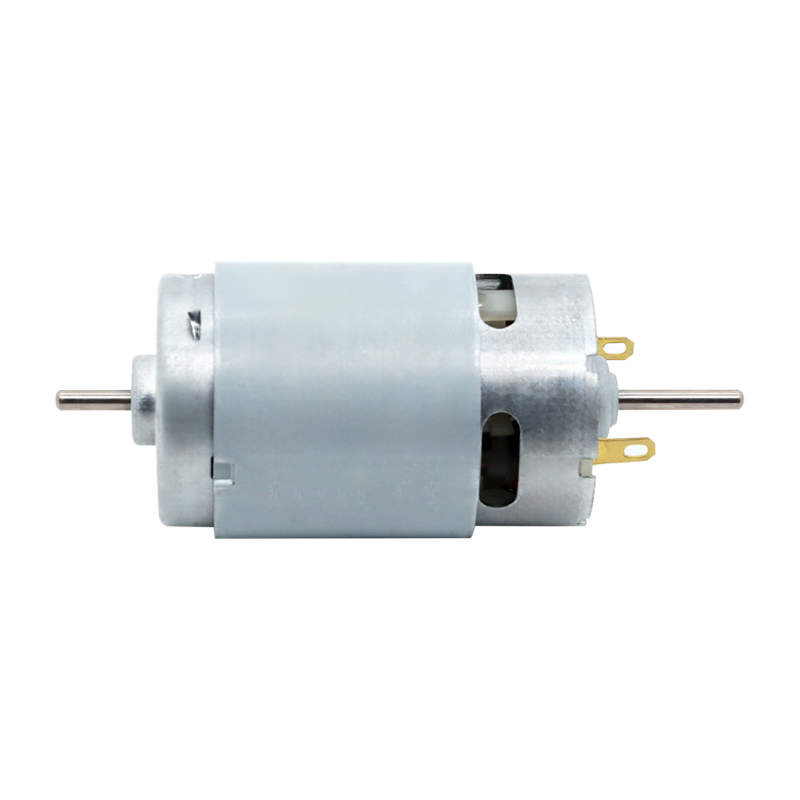 RS-380SL Low-Noise Brushed PMDC Motor for Coffee MakersA quieter RS-380/385-series motor for coffee makers and home products where the motor sits close to users, with customizable shaft and performance options.View Product →
Practical steps that cost little: specify a motor with balanced armature and quality bearings, add a soft coupling or rubber grommet, keep the motor away from thin panels that can act as a sounding board, and include electrical suppression to reduce brush arcing noise in audio-sensitive products.
Consider Duty Cycle, Environment and Service Life
How long the motor runs, and in what conditions, shapes the answer as much as torque does. A pump that runs for hours should be evaluated on continuous duty and heat rise, not on a short burst test. A garden sprayer or a tool used outdoors has to tolerate dust and damp. A medical instrument may need smooth, repeatable motion with very low vibration.
Environment often decides the construction details: sealed end caps, protective coatings, shaft seals, and the choice of lubricant. Our RS735, for example, uses a sealing process for screwdriver applications where dust is inevitable, while the RS540 is built as an energy-saving option for pump duty.
 RS-540 Long-Life Brushed DC Motor for Vacuum CleanersDurable RS-540/545-series brushed motor for vacuum cleaners and pump duty, with precision rotor construction and customizable shaft options for demanding environments.View Product →
It also helps to state life expectancy in hours of actual operation, together with the test conditions behind that number. A figure without conditions is difficult to design around.
Check Mechanical Fit: Gearbox, Shaft and Mounting
Mechanical details cause more late-stage redesigns than electrical ones. Confirm the shaft diameter and length, the flat or keyway, the mounting hole pattern, and the direction of the lead wires. If you need low output speed with high torque, a gear motor combines the motor and reducer into one unit and saves assembly time.
Also think about installation tolerance. A little flexibility in the coupling protects both the motor bearings and the load, and it makes the assembly line more forgiving. Where the device is assembled by hand, connectors and wire length are worth specifying precisely rather than leaving to chance.
Build the Shortlist From Real Applications
One of the quickest ways to narrow the field is to look at products similar to yours. Motor selection patterns repeat across industries, because the loads repeat. A vending machine dispenser, a robot vacuum wheel drive, and an electric pencil sharpener each impose a recognisable combination of torque, duty and noise expectations.
Browsing our application categories is often faster than reading specifications, because it starts from the device rather than the part. From automated equipment to garden tools, the selection logic is documented by use case, and it gives you a realistic starting shortlist before you request samples.
A Practical Selection Checklist
- Define required output speed, running torque and starting torque.
- Confirm the minimum and maximum supply voltage the product will see.
- Record running current and locked-rotor current for driver sizing.
- Decide between brushed and brushless based on life and cost targets.
- Set a noise target and a duty cycle in hours per day.
- List environmental risks: dust, moisture, vibration, temperature.
- Specify shaft, mounting and connector details precisely.
- Test at least two candidates in the real housing, not on a bench.
A motor choice is rarely settled by one number. It is settled by a short list of requirements you can defend, a sample that behaves in the actual product, and a supplier who answers questions about life, noise and consistency without hesitation. That is the conversation we prefer to have early, while the design is still flexible, rather than after the tooling is finished.
If you already have a device in mind, send us the load description, the supply voltage and the space available. From there, narrowing down to a workable motor usually takes far less time than expected.
News
-
Brush DC Motor Origins and Physical Foundations The Brush DC Motor is a pioneer in converting electrical energy into mechanical motion, and its history is closely intertwined with ...
READ MORE -
Who Is Still Using Brushed DC Motors These Days? Brushed DC motors in small appliances Despite the growing adoption of brushless motor technology, small appliances remain a major c...
READ MORE -
Brush DC Motor Applications in Consumer Electronics and Smart Devices Brush DC Motor Role in Consumer Electronics Design Brush DC Motor plays a critical role in the design and func...
READ MORE

Quick Links
 Home


Copyright © Yuyao Hongyang Micromotor Co., Ltd. All rights reserved.

