

 Eng
Eng 
 русский
 Español


What Is a Brush in a DC Motor? Brushed DC Motor Guide
 2026.05.13
 Industry News
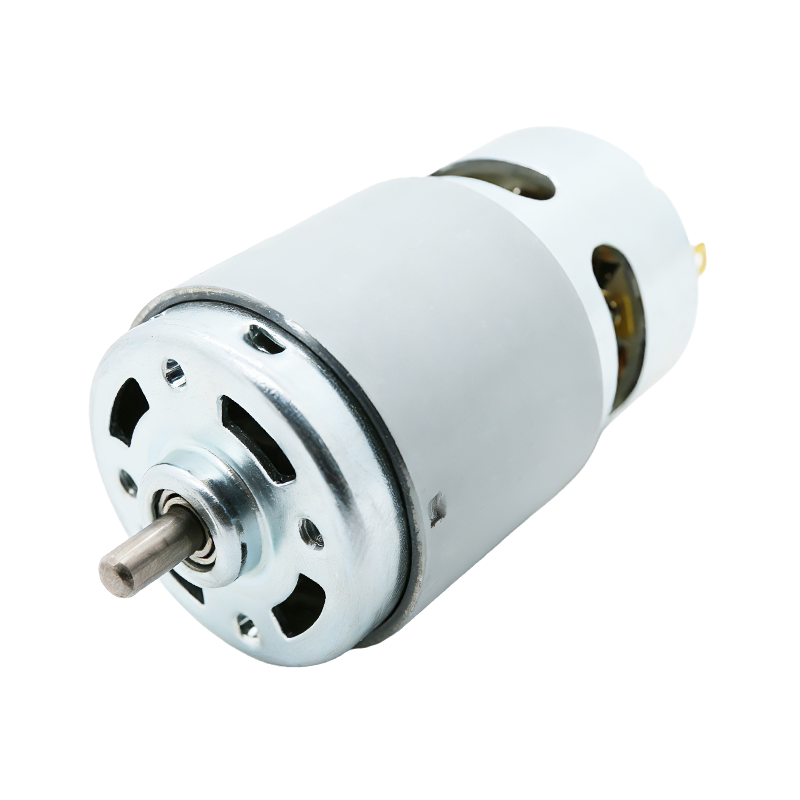
In a DC motor, a brush is a stationary electrical contact — typically made from carbon, graphite, or metal-graphite composite — that presses against a rotating commutator to transfer electrical current between the fixed external circuit and the spinning armature windings. The brush is what makes a brushed DC electric motor mechanically self-commutating: as the rotor turns, the brushes maintain continuous electrical contact with successive commutator segments, automatically reversing current direction in each armature coil at the right moment to sustain rotation. Without brushes, there is no current path into the rotor, and the motor cannot run.
The Role of the Brush in a Brushed DC Electric Motor
To understand what a brush does, it helps to see it in the context of the full commutation system. A brushed DC electric motor has four key components involved in current delivery and switching:
- Armature (rotor) — the rotating assembly wound with copper coils that generate electromagnetic torque when carrying current
- Commutator — a segmented copper ring mounted on the rotor shaft; each segment connects to one end of an armature coil
- Brushes — stationary spring-loaded contacts riding on the commutator surface; typically two brushes positioned 180° apart for a basic two-pole motor
- Brush holders — the mechanical assembly that positions each brush against the commutator at the correct angle and applies consistent contact pressure, usually 15 to 35 kPa for carbon-graphite grades
As the rotor spins, each brush slides from one commutator segment to the next. At each transition, current direction in the coil connected to that segment reverses — this is commutation. The brush performs this switching function purely through its physical contact geometry, with no electronics required. It is this simplicity that makes the brush DC motor one of the most straightforward and widely deployed motor architectures in history.
Types of Brushes Used in DC Motors
Not all DC motor brushes are made from the same material. The composition is selected based on the motor's voltage, current density, speed, and operating environment. There are four principal brush material categories:
| Brush Type | Composition | Best For | Typical Current Density |
|---|---|---|---|
| Carbon-graphite | 60–70% graphite, 20–30% carbon black, binder | General-purpose motors, appliances, power tools | 5–10 A/cm² |
| Electrographitic | Carbon heat-treated above 2,500°C | High-speed motors, traction motors | 8–15 A/cm² |
| Metal-graphite | 30–90% copper or silver powder + graphite | Low-voltage, high-current (automotive starters, micro brush DC motors) | 15–25 A/cm² |
| Natural graphite | Predominantly natural graphite flake | Low-friction slip ring applications, instrumentation | 3–6 A/cm² |
In micro brush DC motors specifically, metal-graphite brushes with high copper content (60–80% Cu) are standard because the low operating voltage (typically 3V to 24V) and high relative current density demand a material with low contact resistance. Carbon-graphite brushes, which have higher resistivity, would cause unacceptable voltage drop across the contact in a 3V or 5V micro motor circuit.
How the Brush and Commutator Work Together to Drive Rotation
The physical commutation process is worth following step by step, because it clarifies both the brush's essential function and its inherent limitations:
- DC current enters the motor through the positive brush, which presses against a commutator segment connected to armature coil A. Current flows through coil A, creating a magnetic field that interacts with the stator field to produce torque.
- The torque causes the rotor to turn. As it does, the commutator segment connected to coil A slides away from the positive brush and a new segment — connected to coil B — slides into contact.
- Simultaneously, the segment previously connected to coil A reaches the negative brush, reversing the current direction through coil A. This reversal keeps the electromagnetic force acting in the same rotational direction rather than decelerating the motor.
- This cycle repeats continuously as the rotor spins, with the brush-commutator interface acting as a mechanical switch that fires at precisely the right rotor angle — approximately every 60° in a standard six-segment commutator.
The brief moment when a brush spans two adjacent commutator segments simultaneously is called the commutation interval. During this interval, the coil being switched is momentarily short-circuited through the brush — proper brush material selection and commutator geometry minimizes the resulting current spike and the electrical arcing it causes.
Structure of a Brush DC Motor: All the Key Components
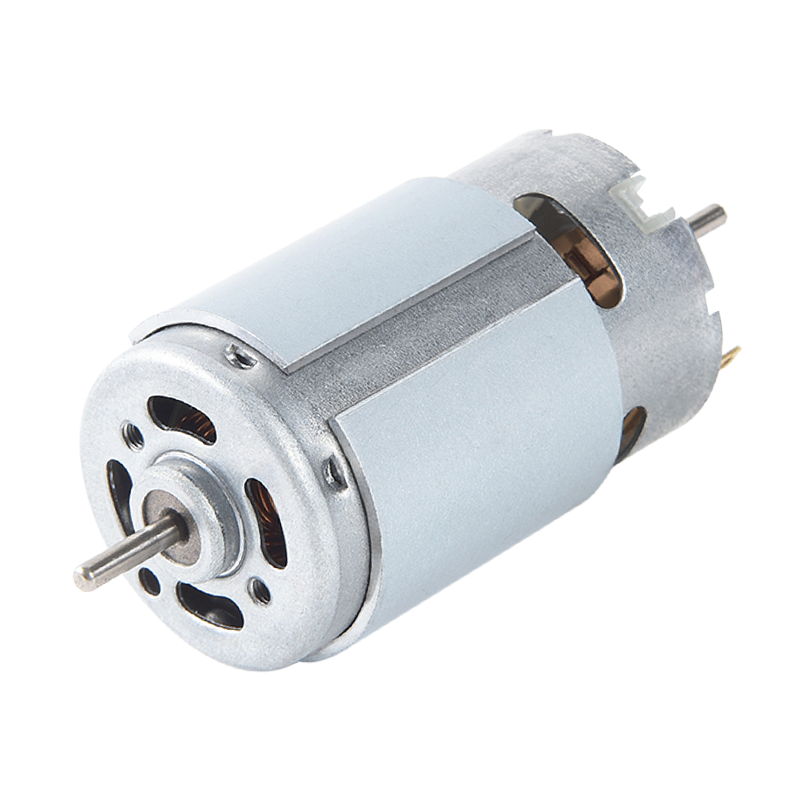
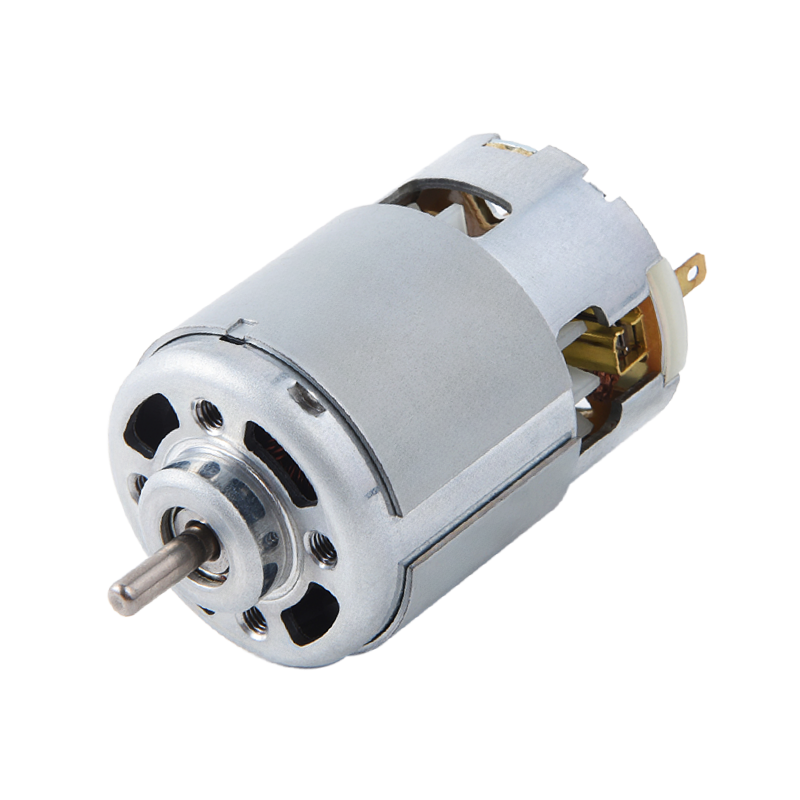
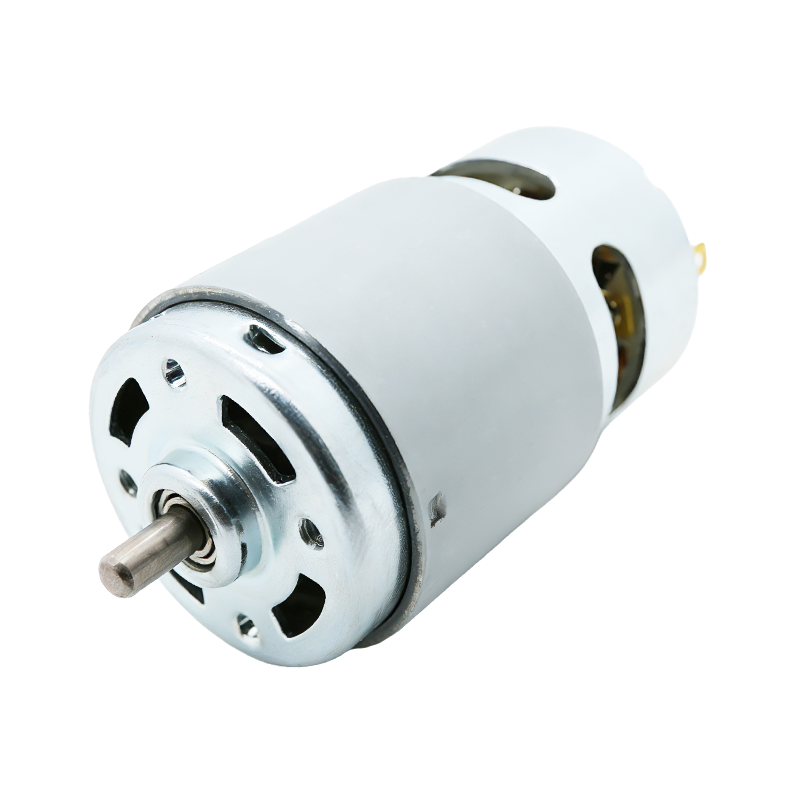
A brush DC motor — whether a large industrial unit or a miniature micro brush DC motor — shares the same fundamental architecture. The following components are present in virtually every brushed DC electric motor:
Stator (Field Assembly)
The stator provides the stationary magnetic field. In permanent magnet brush DC motors (the most common type in small and micro applications), the stator consists of permanent magnets bonded to the inside of the motor housing. In larger wound-field motors, the stator carries electromagnet coils (series, shunt, or compound winding) that are powered by the same DC supply or a separate excitation source.
Rotor (Armature)
The rotor is a laminated iron core wound with multiple coils of copper wire. Laminating the core with thin insulated steel sheets (typically 0.35 to 0.65 mm thick) reduces eddy current losses that would otherwise waste energy and generate heat. The number of armature slots and commutator segments is matched — more slots mean smoother torque output and reduced ripple.
Commutator
The commutator is machined from hard-drawn copper segments separated by mica insulation. In a micro brush DC motor, the commutator may be only a few millimeters in diameter, while industrial motors can have commutators exceeding 500 mm. The copper surface must be maintained within ±0.02 to 0.05 mm runout tolerance to prevent brush bounce, arcing, and uneven wear.
Brushes and Brush Holders
The brushes are held in spring-loaded brush holders that maintain consistent contact pressure against the commutator as the brush wears down over its service life. Most brush DC motors include a wear indicator — either a marked line on the brush body or a minimum length specification — to signal when replacement is needed. A typical carbon-graphite brush for a 1 kW motor starts at 25–40 mm in length and must be replaced when worn to 8–10 mm.
End Bells and Shaft Bearings
The end bells (end caps) close the motor housing and support the rotor shaft through ball bearings or sleeve bearings. They also provide the mounting points for the brush holders, keeping brush-to-commutator alignment stable under load and vibration.
Micro Brush DC Motor: Miniaturization and Special Considerations
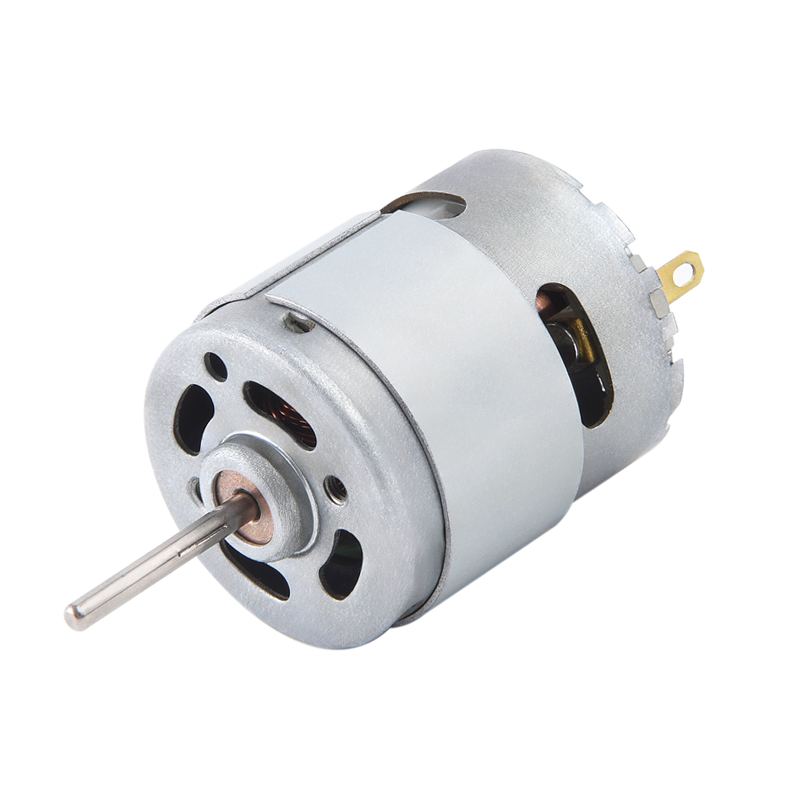
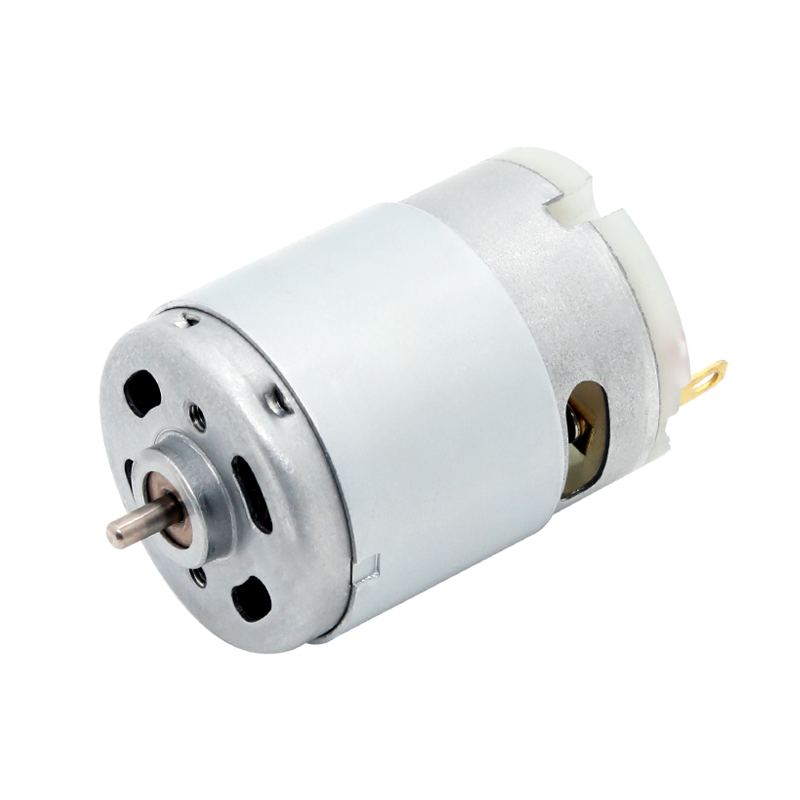
The micro brush DC motor applies the same operating principles as a full-size brushed DC electric motor but shrinks them to diameters typically ranging from 4 mm to 36 mm and power outputs from milliwatts to a few watts. This miniaturization introduces engineering challenges that do not exist at larger scales.
Brush Design in Micro Motors
In a micro brush DC motor, the brushes are often stamped or formed from thin metal-graphite or precious metal alloy sheet rather than pressed carbon blocks. Precious metal brushes (silver-palladium or gold alloys) are used in the smallest motors — such as 6 mm and 8 mm coreless designs — because they provide extremely low contact resistance (under 10 mΩ) and essentially zero wear debris, which would contaminate the tiny internal clearances. The trade-off is cost: precious metal brushes are 5 to 20 times more expensive than carbon grades.
Coreless Rotor Design
Many high-performance micro brush DC motors use a coreless (ironless) rotor — a self-supporting hollow copper coil with no iron laminations. Without the iron core, rotational inertia drops dramatically, allowing the motor to accelerate and decelerate in milliseconds rather than tens of milliseconds. Coreless micro motors are standard in surgical robotics, camera autofocus systems, and precision haptic feedback devices where response time is critical.
Operating Life in Micro Brush DC Motors
Brush wear is the primary life-limiting factor in any brushed DC electric motor, but it is especially critical in micro motors where replacement is often impractical. Manufacturers rate micro brush DC motors with carbon brushes at 500 to 2,000 hours of continuous operation, while precious metal brush versions extend to 3,000 to 5,000 hours under light loads. Load, speed, and environmental humidity all significantly affect actual service life.
Key Performance Characteristics of the Brush DC Motor
The brushed DC electric motor has a well-defined set of performance characteristics that make it predictable and straightforward to control:
| Parameter | Typical Range (Small–Medium Brush DC Motor) | Notes |
|---|---|---|
| Operating voltage | 3V – 240V DC | Micro motors typically 3–24V; industrial up to 700V |
| No-load speed | 1,000 – 30,000 RPM | Coreless micro motors reach 50,000–100,000 RPM |
| Efficiency | 65–85% | Brush contact losses account for 2–5% of input power |
| Speed control method | PWM or variable voltage | Linear speed–voltage relationship simplifies control |
| Starting torque | High (2–5× rated torque) | Advantage over many AC motor types at low speed |
| Brush service life | 500 – 5,000 hours | Depends on material grade, load, and environment |
One of the most practically useful characteristics of the brushed DC electric motor is its linear relationship between speed and applied voltage: doubling the voltage approximately doubles the no-load speed. This makes speed control intuitive and inexpensive — a simple PWM (pulse-width modulation) driver costing a few dollars can provide smooth variable-speed control from near zero to full speed.
Advantages of the Brush DC Motor Over Brushless Designs
Despite the rise of brushless DC motors in many applications, the brushed DC electric motor retains significant advantages in specific contexts:
- Lower system cost — a brush DC motor requires no electronic commutation controller; speed and direction control can be achieved with a single transistor or a basic H-bridge circuit, dramatically reducing total system cost in high-volume consumer applications
- Simple speed control — the linear speed-voltage characteristic means variable voltage or PWM duty cycle directly sets motor speed without feedback sensors in many applications
- High starting torque — brush DC motors develop maximum torque at stall (zero speed), making them ideal for applications requiring high starting force such as automotive windows, seat adjusters, and valve actuators
- Bidirectional control is trivial — reversing motor direction requires only reversing the two supply leads, with no reprogramming or controller modification needed
- Availability and replaceability — brushed DC electric motors are available from hundreds of manufacturers in an enormous range of sizes, voltages, and shaft configurations; replacement parts including brushes are standardized and inexpensive
Limitations Caused by the Brush: Why It Matters in Design Decisions
The brush is also the primary source of limitations in a brushed DC electric motor. Understanding these constraints is essential when deciding between a brush DC motor and a brushless alternative:
Mechanical Wear and Finite Service Life
Brushes wear as they slide against the commutator. The rate of wear depends on current density, spring pressure, speed, and environment — but no brush DC motor avoids eventual brush replacement. In applications demanding tens of thousands of hours of service (HVAC fans, pumps, industrial drives), brushless designs eliminate this maintenance requirement entirely.
Electrical Arcing and EMI Generation
The commutation event — when a brush transitions between segments — generates electrical arcing. This arcing produces electromagnetic interference (EMI) that can disrupt nearby electronics. Brushed DC electric motors used in sensitive environments (medical devices, precision instruments, radio equipment) require EMI suppression components (capacitors, ferrite beads, snubber circuits) that add cost and complexity.
Speed and Power Density Limits
At very high speeds, brush bounce and arcing become severe. Standard carbon brush DC motors are generally limited to commutator surface speeds below 25–35 m/s. Above this threshold, mechanical commutation becomes impractical and brushless or slip-ring designs are preferred. This is why high-performance servo drives above approximately 10 kW have largely transitioned to brushless technology.
Unsuitable for Explosive or Wet Environments
The arcing at the brush-commutator interface makes standard brushed DC electric motors unsuitable for use in flammable gas, dust, or vapor environments without explosion-proof enclosures. Brushless motors, which have no internal arcing source, are inherently safer in these settings.
Where Brush DC Motors Are Used Today
Despite competition from brushless technology, the brushed DC electric motor — including the micro brush DC motor — remains the dominant choice in a broad range of applications where its combination of low cost, simplicity, and performance is unmatched:
| Application Category | Specific Examples | Motor Size |
|---|---|---|
| Automotive | Window lifts, seat adjusters, mirror motors, windshield wipers, fuel pumps | 20–150W |
| Consumer electronics | Electric toothbrushes, shavers, toys, small fans, CD/DVD drives | 0.5–20W |
| Medical devices | Infusion pumps, surgical handpieces, prosthetic joints, hearing aid components | 0.05–10W (micro) |
| Industrial automation | Conveyor actuators, valve positioners, small robotic joints | 10W–5kW |
| Power tools | Corded drills, angle grinders, jigsaws, circular saws | 200W–2kW |
| Robotics and R&D | Micro brush DC motors in mobile robots, camera gimbals, lab automation | 0.1–50W (micro) |
Brush Maintenance and Replacement: Practical Guidelines
In brushed DC electric motors where brush replacement is practical, following a maintenance schedule extends commutator life and prevents motor failure:
- Inspect brushes every 500 operating hours in high-duty cycle applications; every 1,000–2,000 hours in intermittent use environments
- Replace brushes before they reach the minimum length marked on the brush or specified in the motor datasheet — running worn brushes causes the spring-loaded holder to bottom out, resulting in sudden loss of contact pressure and severe arcing that damages the commutator within minutes
- After installing new brushes, allow a run-in (seating) period of 1 to 3 hours at light load before full-load operation; new brushes have flat contact faces that must conform to the commutator's curved surface for full contact area
- Clean the commutator surface with a lint-free cloth and isopropyl alcohol during brush changes; light oxidation is normal and actually beneficial (the thin oxide layer reduces friction), but thick carbon deposits increase contact resistance
- Always replace brushes in matched pairs — asymmetric brush wear causes uneven current distribution and accelerates commutator wear on the side served by the shorter brush
In a micro brush DC motor, brushes are generally not user-serviceable due to the small physical scale. When a micro motor reaches end of brush life, the complete motor is typically replaced — which is factored into the total cost of ownership at the system design stage.
News
-
Brush DC Motor Origins and Physical Foundations The Brush DC Motor is a pioneer in converting electrical energy into mechanical motion, and its history is closely intertwined with ...
READ MORE -
Who Is Still Using Brushed DC Motors These Days? Brushed DC motors in small appliances Despite the growing adoption of brushless motor technology, small appliances remain a major c...
READ MORE -
Brush DC Motor Applications in Consumer Electronics and Smart Devices Brush DC Motor Role in Consumer Electronics Design Brush DC Motor plays a critical role in the design and func...
READ MORE

Quick Links
 Home
Home


Copyright © Yuyao Hongyang Micromotor Co., Ltd. All rights reserved.

